Many doctors in India already use ChatGPT, often quietly: to draft a referral letter, summarise a paper, explain a condition in simpler words or write an Instagram caption. Used well, it saves hours. Used carelessly, it can leak patient data, invent references or break the NMC's 2026 advertising rules.
This guide covers ChatGPT for doctors: where it genuinely helps, what never to put into it, the rules that apply in India, and prompts that work. The same applies to Gemini, Claude, Copilot and similar tools.
What doctors use it for
In the practice
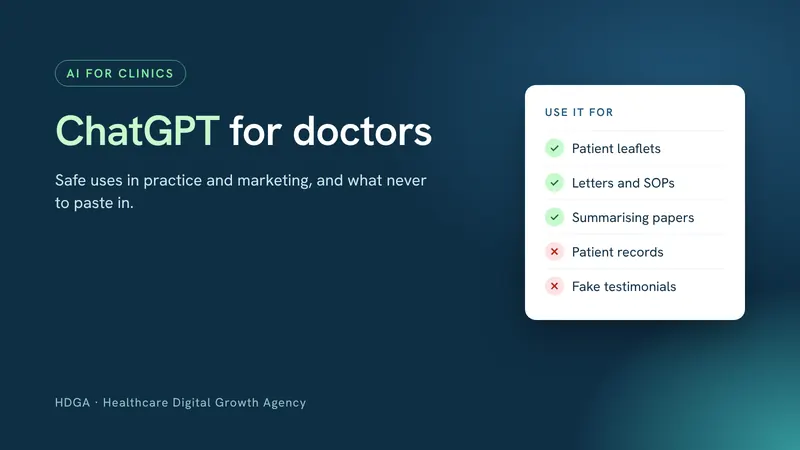
- Letters and documents: referral letters, fitness certificates, insurance query replies and discharge summary templates, from your own notes with no patient identifiers.
- Patient leaflets: turning your advice into plain English, Hindi or regional languages at a reading level patients understand.
- Literature help: summarising papers you provide, comparing guidelines and drafting journal club notes.
- Admin: clinic policies, SOPs, staff training material, rosters and email replies.
- Learning: quizzing yourself, revising topics and preparing talks.
In marketing
- Drafting education posts and blog outlines for you to rewrite and check.
- Translating your own content into the languages your patients speak.
- Writing FAQs based on the questions your front desk actually gets.
- Alt text, captions and video subtitles.
What never to put in
- patient names, phone numbers, addresses, ID numbers or dates of birth
- scans, photos or reports with identifying details
- full case histories that someone could recognise
- anything a patient told you in confidence
Under the Digital Personal Data Protection Act, health information is personal data, and pasting it into a consumer AI tool may be processing it for a purpose the patient never agreed to. The NMC's 2026 advertising guidelines also say that any use of patient information as input for an AI system must comply with privacy requirements. If you must use AI on clinical data, use a tool provided by your hospital under a written data agreement, or remove all identifiers first.
OpenAI launched a free ChatGPT for Clinicians in April 2026, with medical citations and a business associate agreement for eligible accounts, but at launch it was limited to verified clinicians in the United States. Do not assume a tool's protections apply in India unless the agreement says so.
Where it goes wrong
- Invented references. AI tools still produce plausible citations to papers that do not exist. Check every reference yourself.
- Out-of-date or foreign guidance. Answers may reflect US or UK practice, old guidelines or drug doses that differ in India.
- Confident errors. The tone is the same whether the answer is right or wrong.
- Promotional language. Ask for a clinic post and you will often get "best care", "painless" and "state-of-the-art", all of which the NMC guidelines restrict.
The rules that apply
| Rule | What it means for AI use |
|---|---|
| NMC Guidelines on Ethical Advertising and Public Communication, 2026 | AI must not create or alter a patient's image, testimonial, voice or outcome; AI-generated promotional content must carry a source mark stating it was made by AI |
| Telemedicine Practice Guidelines, 2020 | AI and machine learning tools cannot counsel patients or prescribe medicines directly; the doctor is responsible |
| DPDP Act, 2023 and DPDP Rules, 2025 | Patient data needs a lawful basis, clear purpose and safeguards |
| ICMR ethical guidelines for AI in healthcare, 2023 | Human oversight, accountability, data privacy and patient consent |
The short version: AI can help you draft, but you are responsible for every word that goes to a patient or the public. See our explainer on the NMC AI-generated content rule.
Prompts that work
Patient leaflet
"Write a one-page patient leaflet on caring for a plaster cast, for adults in India with no medical background. Use short sentences, simple words and headings. Include when to come back urgently. Do not include any promises about outcomes."
Translation
"Translate this leaflet into simple Marathi suitable for patients. Keep medical terms in English in brackets the first time they appear."
Education post
"Draft a 150-word Instagram caption explaining the difference between a cold and flu. Educational only. No promotional words such as best, painless, guaranteed or free. End with: Dr [Name], [Qualifications], Reg. No. [number]."
Paper summary
"Summarise the attached paper in 200 words: study design, population, main results with numbers, and limitations. Do not add information that is not in the paper."
Always review, correct and rewrite the output in your own voice before using it.
A simple clinic AI policy
Put these on one page for your team:
- Approved tools, and who may use them.
- No identifiable patient data in any AI tool except those approved for it.
- Every medical statement is checked by a doctor before it reaches a patient or the public.
- AI-made images, voices and avatars are labelled.
- No AI testimonials, patient stories or before-and-after images.
- A record of what was published, which tool helped, and who approved it.
Common questions
Can doctors use ChatGPT in India?
Yes, for drafting, learning and admin, as long as no identifiable patient data goes in, and the doctor checks and takes responsibility for the output.
Can ChatGPT write my clinic's blog posts?
It can help you draft them. A doctor should rewrite, check every fact and sign off. Search engines and AI assistants favour content with named, qualified reviewers, and the NMC guidelines require AI-generated promotional content to be labelled.
Can I use ChatGPT to reply to patient messages?
Only for general, non-clinical replies such as timings or directions. Clinical advice should come from the doctor after a proper consultation.
Is ChatGPT for Clinicians available in India?
At launch in April 2026 it was available to verified clinicians in the United States only, with other countries planned later.
What to do next
Write your one-page AI policy this week and share it with everyone who writes for your practice. If you would like help building AI into your content and marketing safely, see our healthcare GEO services and AI transformation services, or book a call.
Sources
- TechTarget: OpenAI launches ChatGPT for Clinicians (23 April 2026)
- Medical Dialogues: doctors and hospitals cannot use AI-generated promotional campaigns for commercial interest (8 October 2026)
- ICMR: ethical guidelines for application of AI in biomedical research and healthcare (2023)
- Down To Earth: ICMR releases guidelines for AI use in the health sector (20 March 2023)
- NRCeS: Telemedicine Practice Guidelines (2020)