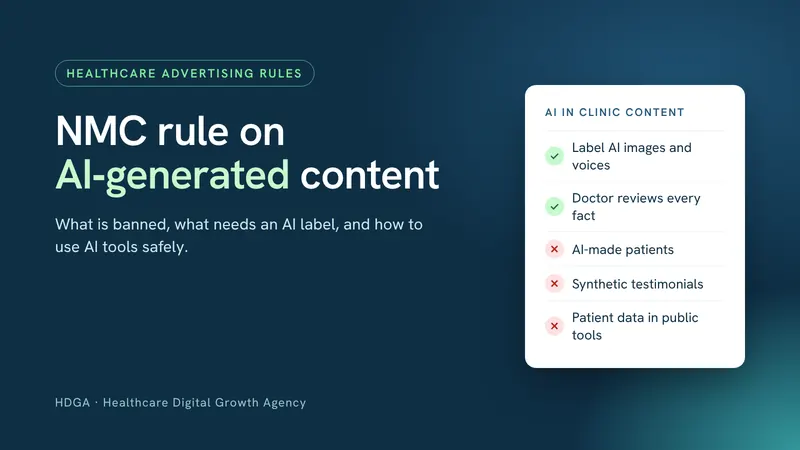
Most clinic marketing teams now use AI somewhere: to draft captions, rewrite blog posts, make graphics or cut reels. The National Medical Commission's Guidelines on Ethical Advertising and Public Communication, issued on 6 October 2026, are the first Indian medical rules to deal with this directly. This explainer covers what the NMC AI-generated content rule says, what it bans outright, when content needs a label, and how to keep using AI tools safely.
For the guidelines as a whole, read our NMC advertising guidelines 2026 explainer.
This guide summarises the guidelines as published and reported in October 2026. It is not legal advice; check specific cases with your State Medical Council or a lawyer.
The rule in four lines
- An AI-generated promotional campaign for commercial interest is prohibited.
- AI must not be used to create or manipulate a patient's image, testimonial, voice or clinical outcome, or to create a synthetic endorsement from a real patient, doctor or anyone else.
- AI-generated promotional content that otherwise follows the guidelines must carry a source mark stating that it was made by AI.
- Any patient information used as input for an AI system must comply with privacy law.
As reported, these provisions sit in Chapter II of the guidelines, among the prohibited advertising practices for registered medical practitioners and clinical establishments.
What is banned outright
These are prohibited whether or not you add a label:
- Fake patients and fake results. AI-made "patient" photos, voices, stories or before-and-after images. Testimonials are already prohibited; synthetic ones are explicitly called out. See our guide to the NMC testimonial rules.
- Synthetic endorsements. An AI avatar or cloned voice presented as a real doctor, celebrity or patient vouching for you.
- Misleading claims about care. AI content that makes misleading, deceptive or unverifiable claims about diagnosis, treatment, outcomes, qualifications or services.
- Impersonation. Content that pretends to be a person it is not.
When AI content needs a label
Promotional content made with AI that otherwise complies with the guidelines can be used, but it must carry a source mark explicitly stating that its origin is AI. The guidelines also require appropriate disclosure where the artificial nature of content could matter to how the audience understands it.
In practice, label anything a patient might reasonably take as real:
| Content | Label it? |
|---|---|
| AI-generated illustration of the knee joint in an education post | Yes, a short "AI-generated illustration" caption |
| AI voice-over on a clinic video | Yes |
| AI avatar presenting health information | Yes, clearly and at the start |
| Caption drafted with AI, then rewritten and checked by the doctor | Not required by the wording reported, but disclosure does no harm |
| AI-made "patient" image or testimonial | Not allowed, even with a label |
A simple, visible line works: "Image generated with AI" or "This video uses an AI-generated voice." Put it on the image or in the first line of the caption, not buried in hashtags.
Patient data and AI tools
Pasting a patient's report, photo or chat into a public AI tool to draft a reply or a case post can breach both the NMC guidelines and the Digital Personal Data Protection Act. Before any patient information goes into an AI system:
- remove names, numbers, dates and faces, or don't use the data at all
- use tools with a written agreement on data use and storage
- record the purpose and who approved it
- never use identifiable patient data in marketing content
Our guides to DPDP consent forms and the DPDP Rules for hospitals and clinics cover consent in more detail.
A safe AI workflow for clinic content
- Use AI to draft, not to decide. Outlines, first drafts, translations and alt text are fine starting points.
- Doctor review before publishing. A named doctor checks every medical statement and signs off. Show the reviewer's name, qualification, registration number and date on the page.
- Check every fact against a source. AI tools invent studies, figures and guidelines. Link to the real source or remove the claim.
- Strip promotion. Remove "best", "painless", "guaranteed", offers and urgency. The output should read as education.
- Label what is synthetic. Images, voices and avatars get a visible AI source mark.
- Keep a record. Note which tool was used, by whom, and who approved the final version.
This also helps with search. Google and AI answer engines look for content written or reviewed by identifiable experts, which is why our guides to generative engine optimization stress named medical reviewers.
What this means for agencies
The guidelines make clear that a doctor or hospital cannot avoid responsibility by publishing promotional material through an agency. If your agency uses AI, ask it in writing:
- which tools it uses and what data goes into them
- how AI-made images, voices and video are labelled
- who checks medical facts before anything is published
- that no synthetic patients, testimonials or endorsements will ever be produced
Common questions
Is all AI-generated content banned for doctors?
No. AI-generated content that follows the guidelines may be used, with a source mark stating it was made by AI. What is banned is AI used for fake patients, outcomes or endorsements, misleading claims, and AI promotional campaigns for commercial interest.
Do I need to label a blog post I drafted with ChatGPT?
The reported wording targets AI-generated promotional content and content whose artificial nature could matter to the reader. If a doctor has substantially rewritten and verified a draft, it is their content. If you publish AI text largely as generated, label it, or better, rewrite it.
Can I use an AI avatar of myself to make health videos?
It is safer to film yourself. If you use an avatar, label it clearly as AI-generated, keep the content educational and make sure it never implies the avatar is a real recording.
Do government health campaigns have to follow this?
As reported, campaigns on central and state government programmes and schemes are exempt from the guidelines.
What to do next
Review the last three months of your posts for AI images, voices and avatars, add source marks where needed, and remove anything that shows a synthetic patient or outcome. If you want an independent review, see our NMC advertising compliance audit and healthcare compliance advisory, or book a call.
Sources
- Medical Dialogues: doctors and hospitals cannot use AI-generated promotional campaigns for commercial interest (8 October 2026)
- The Policy Edge: NMC restricts misleading medical ads, paid rankings and AI-generated testimonials (10 October 2026)
- MedBound Times: NMC new rules for doctors on social media and AI (8 October 2026)