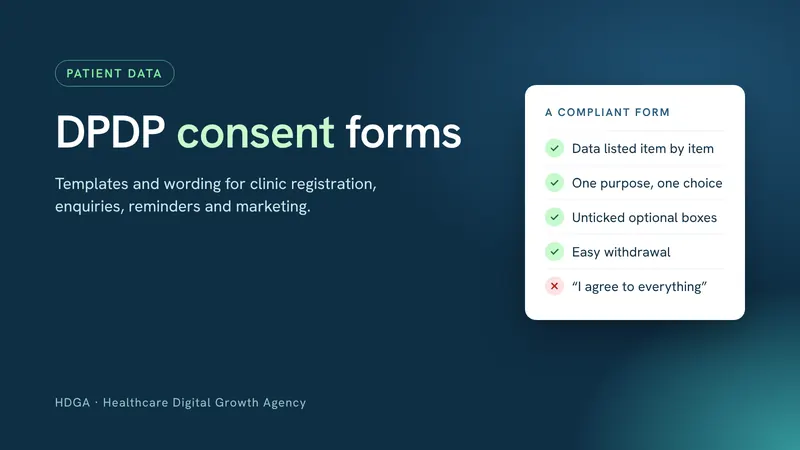
Most clinic forms in India were written before the Digital Personal Data Protection Act existed. A single line at the bottom, such as "I agree to the terms and conditions", will not meet the standard the Act and the DPDP Rules, 2025 set. This guide gives you a DPDP consent form structure and ready-to-adapt wording for the forms a clinic or hospital actually uses: patient registration, website enquiries, reminders, marketing and children's care.
For the full picture of the rules and deadlines, read our DPDP Rules guide for hospitals and clinic chains.
These templates are a starting point, not legal advice. Have your lawyer adapt them to your services, systems and state, and keep them in step with any change to the rules.
When the requirements apply
Under the DPDP Rules, 2025, the duties on notice and consent apply from 13 May 2027. The government consulted in early 2026 on bringing that date forward to 13 November 2026; as of late October 2026 no amending notification had been reported. Forms, systems and staff training take months to change, so start now.
What every consent notice must include
Before you collect personal data on the basis of consent, give a notice that stands on its own, separate from your terms and conditions, written in clear and plain language. It must set out:
- The personal data you collect, item by item. Not "your information", but name, phone number, date of birth, symptoms and so on.
- The specific purpose for each item, and what service it makes possible.
- How to withdraw consent, in a way as easy as giving it.
- How to exercise rights: access, correction, erasure, nominating someone, and raising a grievance.
- How to complain to the Data Protection Board of India.
- Who to contact: the person or Data Protection Officer who answers questions about your data handling.
The person must be able to read the notice in English or in any language listed in the Eighth Schedule to the Constitution, so clinics serving Marathi, Tamil or Bengali speakers should offer the notice in those languages.
Consent itself must be free, specific, informed, unconditional and unambiguous, given by a clear action such as ticking an unticked box. Pre-ticked boxes, consent buried in terms, and making treatment depend on agreeing to marketing all fail.
The golden rule: one purpose, one choice
Most clinic forms bundle everything into one signature. Split them:
| Purpose | Can care depend on it? | Separate box? |
|---|---|---|
| Registering and treating the patient | Yes; care needs this data | Required, but explained |
| Appointment reminders and reports by WhatsApp or SMS | No | Yes, optional |
| Health tips and newsletters | No | Yes, optional |
| Promotional messages about other services | No | Yes, optional |
| Clinical photos for the medical record | Depends on the treatment | Separate form |
Medical procedure consent, the informed consent a doctor takes before surgery, is a different legal document. Do not merge it with your DPDP notice.
Template 1: Patient registration notice
Use at the front desk or in your patient app.
How [Clinic name] uses your personal data
We collect your name, age, sex, phone number, address, emergency contact, medical history, symptoms, test results and payment details to register you, diagnose and treat you, keep your medical record, bill you or your insurer, and meet our legal obligations. We cannot provide care without this information.
We keep your medical record for [period required by law or our policy], and other details only for as long as we need them.
We share your data only with those involved in your care, such as laboratories and specialists we refer you to, your insurer or TPA if you claim, and service providers who host our systems under contract. We do not sell your data.
You can ask for a summary of your data, correct it, ask us to erase what we no longer need to keep, nominate someone to act for you, and raise a grievance by contacting [name or role], [email or phone], or at the reception desk. You can also complain to the Data Protection Board of India.
☐ I have read this notice and agree to [Clinic name] using my personal data for my care as described.
Template 2: Website enquiry or appointment form
Place it directly above the submit button. Never ask for symptoms or records in a marketing form unless you need them.
How we use your details. [Clinic name] will use your name, phone number, email and message only to reply to your enquiry and arrange your appointment. We keep enquiries for [12 months] unless you become a patient. You can withdraw consent, or ask us to correct or delete your details, at [link or email]. You can also complain to the Data Protection Board of India. Please do not include medical records in this form.
☐ I agree that [Clinic name] may use these details to respond to my enquiry. (required)
☐ Send me occasional health information and news from [Clinic name]. You can unsubscribe at any time. (optional)
Template 3: Reminders and reports on WhatsApp or SMS
Messages from [Clinic name]. With your agreement, we will send appointment reminders, report-ready alerts and follow-up instructions to [phone number] by WhatsApp or SMS. We use only your name, phone number and appointment details for this. Reply STOP or tell the reception desk at any time to stop these messages; your care will not be affected.
☐ Yes, send me reminders and report alerts on WhatsApp or SMS.
Template 4: Marketing consent
Keep this separate from everything above, and never pre-tick it.
Health tips and updates. We would like to send you health information, check-up reminders and news about [Clinic name]'s services by [WhatsApp, SMS, email]. We will use your name and contact details only for this. You can withdraw consent at any time by replying STOP, clicking unsubscribe, or telling us at [contact].
☐ Yes, send me health tips and updates. (optional)
The NMC's 2026 advertising guidelines and the dental Code of Ethics still apply to what you send, so keep messages factual and free of offers that read as inducements. See our guide to what hospitals may advertise.
Template 5: Parent or guardian notice for a child
For anyone under 18, a parent or lawful guardian acts for the child. The DPDP Rules let clinical establishments and healthcare professionals process a child's data without verifiable parental consent to the extent needed to provide health services to the child. That exemption does not cover marketing, so any optional box needs the parent's verified agreement.
For the parent or guardian of [child's name]. We use your child's name, age, medical history and test results, and your name and contact details, to provide your child's care and keep their record. For optional reminders and health updates, we need your consent as their parent or guardian.
Parent or guardian name: ________ Relationship: ________ Phone (verified by OTP): ________
☐ I am the parent or lawful guardian and agree to reminders about my child's care.
Template 6: Withdrawal and data request form
Make withdrawing as easy as agreeing: one short form, at the desk and online.
Change your data choices. Name ____ Phone ____
☐ Stop WhatsApp and SMS reminders ☐ Stop health tips and updates ☐ Send me a summary of my data ☐ Correct my data ☐ Delete data you no longer need to keep ☐ Other: ____
We will act on your request within [X] days, and no later than 90 days.
Record-keeping that makes consent provable
- Record when and how each consent was given, the notice version shown, and which boxes were ticked.
- Store consent with the patient or lead record, in your hospital system or CRM.
- When someone withdraws, stop the processing promptly and tell any processor, such as your WhatsApp provider or agency, to stop too.
- Keep notices versioned and dated, like the "notice_version" field we use on our own forms.
Common mistakes
- One "I agree to everything" checkbox
- Pre-ticked marketing boxes
- Making appointment booking conditional on marketing consent
- Notices only in English for a Hindi- or Marathi-speaking patient base
- Using registration data to build ad audiences without separate consent
- No working way to withdraw
Common questions
Do we need consent to treat a patient?
Care depends on processing the patient's data, so give a clear notice and record agreement at registration. In a medical emergency involving a threat to life or health, the Act allows processing without consent.
Can one form cover registration and marketing?
One page can carry both, as long as each purpose has its own clear, optional choice and care does not depend on agreeing to marketing.
Is a signature needed, or is a tick box enough?
The Act requires a clear affirmative action. A tick box, an OTP confirmation or a signature can all work, as long as you can prove it later.
When do these requirements start?
The main duties apply from 13 May 2027, unless the government brings the date forward as it has proposed.
What to do next
List every place you collect personal data: the front desk, website forms, WhatsApp, call centre and camps. Then rewrite each form using the structure above. If you would like help mapping your data and rewriting your forms and systems, see our DPDP Act implementation service or book a call. Our compliance checklist includes more consent wording you can adapt.
Sources
- DPDP Rules, 2025: compliance timeline (King Stubb & Kasiva, updated September 2026)
- India Briefing: DPDP (Removal of Difficulties) Order, 2026 (7 October 2026)
- Mondaq: MeitY plans to cut short the DPDP compliance timeline
- Storyboard18: DPDP Rules exemptions for healthcare providers processing children's data
- Ministry of Electronics and Information Technology