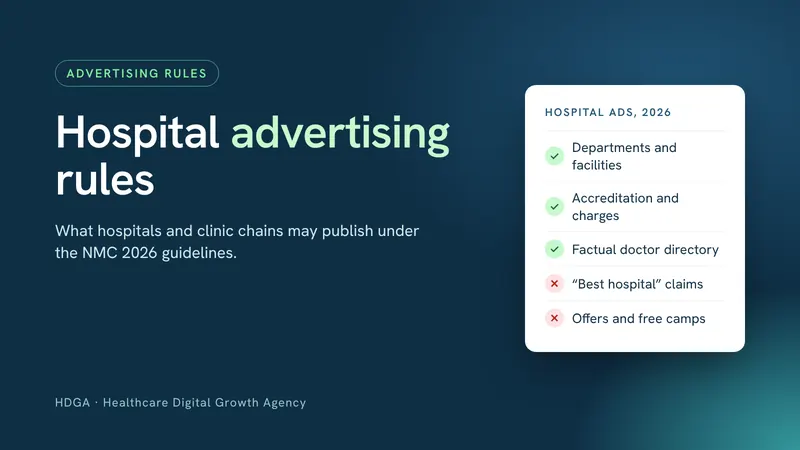
Hospitals have more room to advertise than individual doctors, but since 6 October 2026 that room is defined precisely. The National Medical Commission's Guidelines on Ethical Advertising and Public Communication say what hospitals, clinics and clinic chains may publish, and the answer is facts. Claims, offers and patient stories are out.
This guide sets out the hospital advertising rules in India as they now stand: what is allowed, what is banned, how the Clinical Establishments Act fits in, and what to check on each channel. For the rules on individual doctors, see our NMC advertising guidelines 2026 explainer.
This article is based on the published text of the guidelines (NMC public notice dated 6 October 2026), with section numbers so you can check them. It is not legal advice.
The rule in one line
Section 9.1 puts it plainly: clinical establishments may advertise only factual information. Everything below follows from that.
How the guidelines apply to hospitals
- They are read with your registration law. For hospitals and clinics, the guidelines are read with the applicable Clinical Establishments Act or state law, and where the two genuinely conflict, that law prevails (section 4.3). Our Clinical Establishment Act registration guide explains which law applies where.
- Penalties come through that law. Unethical advertising by hospitals is dealt with under the applicable Clinical Establishments Act and rules, or other state law (section 10.1 and section 11.5). A doctor personally responsible for the content can be examined separately by the State Medical Council.
- Outsourcing does not move responsibility. Using an agency, influencer or platform does not by itself absolve a hospital of responsibility (section 4.4).
What hospitals may publish
Section 8.3(i) allows factual, objective and verifiable information about:
- the hospital's name, location and contact details
- departments, specialties and services
- facilities, equipment and emergency services
- accreditation status, such as NABH or NABL, stated accurately
- charges, and other institutional details the law allows
Several other provisions widen this a little:
- A doctor directory. A website directory listing your doctors with their names, recognised qualifications, specialties, registration details and availability serves patients and is treated as distinct from promotional advertising (section 9.1).
- News of equipment and services. You may tell people that a service or piece of equipment is available, as factual information, without claims of superiority or guaranteed results (section 3.2, Explanation II).
- Fees and packages. Charges, packages and fees may be disclosed if they are factual, transparent and not misleading (section 8.1(x)).
- Rankings and awards. You may mention a ranking or award only if it can be independently verified, and you should disclose who gave it, how and when (section 8.1(ix)).
- Formal announcements. Opening, moving and changes to services may be announced in a factual, non-promotional and limited way (section 9.3).
- Public health campaigns. Taking part in awareness campaigns is fine if they do not solicit patients (section 5.1).
What hospitals may not publish
- Solicitation, inducement or superiority claims, and guarantees of cure or outcome (section 8.3(ii)).
- Superlatives such as "best doctors", "100% success" or "miracle treatment" (section 8.1(iii)).
- Discounts, limited-period offers, contests, coupons, gifts or cashback that encourage unnecessary care or amount to solicitation (section 8.1(x)). This covers "free consultation this week" and festival offers.
- Promotional portrayal of an individual doctor, including using a doctor's photograph as self-advertisement (section 9.2).
- Patient testimonials and patient images. Patients' photos, videos and clinical images may not be used for advertising unless the law permits it, and consent alone does not make a testimonial acceptable (sections 6.1 and 6.2). See our guide to the NMC testimonial rules.
- Fake, paid or manipulated reviews, followers or ratings (section 3.2, Explanation V, and section 8.1(xii)).
- Agency or influencer fees linked to patients. Payment must not be tied to procuring or referring individual patients (section 8.1(viii)).
- Unverifiable claims on hoardings. Hoardings may carry only factual information (section 5.2).
A factual message can still break the rules through the way it is used. Repeating it so often, or presenting it in such a way, that it becomes solicitation is itself prohibited.
Rewriting common hospital ads
| Before | After |
|---|---|
| "Mumbai's best cardiac hospital" | "Cardiology and cardiac surgery, 24-hour cath lab, NABH accredited" |
| "100% success in knee replacement" | "Knee replacement: what to expect, recovery time and package charges" |
| "Free health check-up this Diwali" | "Health check-up packages: tests included and charges" |
| "Dr Sharma, the city's top surgeon" | Doctor directory entry: name, qualifications, specialty, registration number, OPD days |
| Patient video: "They saved my life" | Explainer from a doctor on symptoms of a heart attack, with their registration details |
| "Ranked No. 1 hospital" | "Ranked [position] in [survey name, year], by [publisher]; methodology at [link]", only if independently verifiable |
Channel-by-channel checklist
- Website: turn doctor profiles into factual directory entries; remove testimonials, before-and-after images, "best" claims and offer banners; publish charges and packages factually.
- Google Business Profile: keep the name exactly as registered, list departments and hours, and check posts for offers and claims. Reply to reviews without confirming anyone was a patient.
- Google Ads: factual ads for departments and services are not banned, as long as they make no superiority claims, guarantees or offers. Landing pages must meet the same standard. See our healthcare Google Ads page.
- Meta and Instagram: move from promotion to education; remove patient stories, result reels and influencer posts.
- Hoardings, print and radio: facilities, services, location and accreditation only.
- Health camps: run them as public health activity, not as a way to bring patients in with free procedures.
- WhatsApp: send appointment and health information to people who agreed to receive it; do not broadcast offers. Keep consent records under the DPDP Act.
- Listing platforms: platforms may not sell higher rankings for doctors (section 9.4). Review anything you pay a platform for.
- Agencies: contracts based on work done, not leads or patients, with written approval of everything published.
Rate display goes beyond advertising
Separately from the NMC guidelines, registered clinical establishments must display their rates for services and facilities prominently, in the local language and in English, under the Clinical Establishments (Central Government) Rules, 2012. On 12 October 2026 the Union Health Ministry asked states to make sure hospitals display their rates and that patients can easily find treatment costs, and to encourage package rates for international patients. Publishing the same factual information on your website helps patients and fits the advertising rules.
Common questions
Can a hospital still advertise?
Yes. Hospitals may advertise factual information about who they are, what they offer and what it costs. What they cannot do is solicit, induce or claim superiority.
Can we mention our NABH accreditation?
Yes, as long as it is stated accurately, including its scope.
Can we advertise our doctors?
You can list them in a factual directory with qualifications, specialties, registration and availability. Promoting an individual doctor, or using their photograph as self-advertisement, is not allowed.
Are package prices allowed?
Yes, if they are factual, transparent and not misleading. Presenting them as limited-time offers or discounts to draw patients in is not.
What if our state law says something different?
For hospitals and clinics, the applicable Clinical Establishments Act or state law prevails where there is a genuine conflict. Check your state's rules as well as the guidelines.
What to do next
Start with the channels patients see most: your website, Google Business Profile and running ads. If you want every channel reviewed against the guidelines, our healthcare compliance advisory team can audit them and rewrite what needs changing, or book a call. Our healthcare marketing compliance checklist is a good place to start on your own.
Sources
- NMC Guidelines on Ethical Advertising and Public Communication, public notice dated 6 October 2026 (PDF via Medical Dialogues)
- Medical Dialogues: NMC specifies permitted and prohibited advertising practices for hospitals (18 October 2026)
- Medical Dialogues: NMC lists exceptions to prohibited advertising practices
- The South First: Centre asks states to ensure hospitals display service rates (13 October 2026)
- National Medical Commission