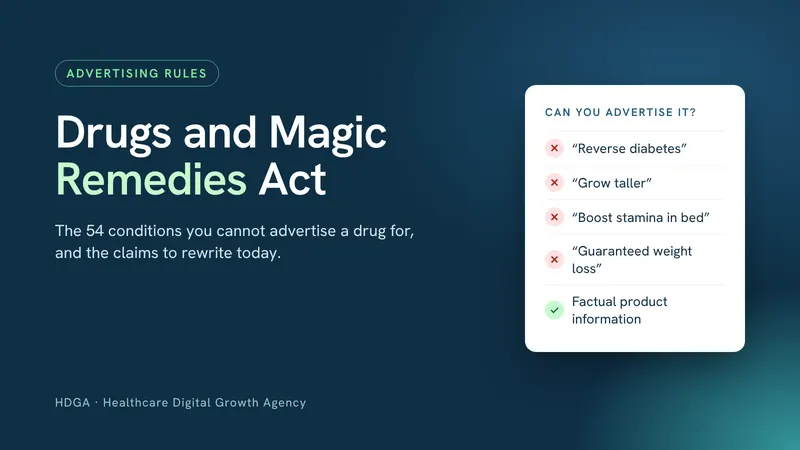
The Drugs and Magic Remedies Act is more than 70 years old, and for most of that time it was barely enforced. That changed in 2024 and 2025, when the Supreme Court used it to rein in misleading health advertising and told every state to start acting on complaints. If you advertise a medicine, supplement, herbal product or any treatment that involves one, this is the law that can turn an ad into a criminal case.
This guide explains what the Act bans, the 54 conditions you cannot advertise a drug for, who is liable, and how to check your claims. It sits alongside the newer rules for doctors and hospitals in our NMC advertising guidelines 2026 explainer.
This is a practical summary of the Act's text and recent court orders, not legal advice. Take advice before running any campaign that names a disease or condition.
What the Act covers
The full name is the Drugs and Magic Remedies (Objectionable Advertisements) Act, 1954. Three definitions make it wider than most people expect:
- Advertisement includes any notice, circular, label, wrapper or other document, and any announcement made orally or by light, sound or smoke. Social media posts, videos, packaging and websites are all advertisements.
- Drug includes any medicine for human or animal use, and any article other than food that is intended to affect the structure or any function of the body. Supplements, herbal and AYUSH products, oils and devices can all fall within it.
- Magic remedy includes a talisman, mantra, kavacha or any other charm said to have miraculous powers.
The Act applies whatever the system of medicine: allopathic, Ayurvedic, homoeopathic, Unani or none.
The four outright bans
Section 3 prohibits any advertisement that suggests a drug should be used for:
- procuring a miscarriage or preventing conception in women
- maintaining or improving sexual pleasure
- correcting menstrual disorders in women
- diagnosing, curing, mitigating, treating or preventing any disease, disorder or condition in the Schedule
These bans do not depend on whether the claim is true. A drug that genuinely helps with a scheduled condition still cannot be advertised for it to the public.
The 54 scheduled conditions
The Schedule lists the conditions that drug advertising must never target. Several are among the most common in Indian health marketing today:
- Metabolic and heart: diabetes, heart diseases, high or low blood pressure, arteriosclerosis, obesity, goitre
- Cancer and growths: cancer, tumours, ulcers of the gastrointestinal tract
- Brain and nerves: diseases and disorders of the brain, disorders of the nervous system, epilepsy, fits, paralysis, infantile paralysis, insanity, hysteria, nervous debility, locomotor ataxia
- Eyes and ears: blindness, cataract, glaucoma, trachoma, diseases and disorders of the optical system, deafness
- Women's health: diseases and disorders of the uterus, disorders of menstrual flow, female diseases in general, sterility in women, forms and structure of the female bust
- Men's and sexual health: sexual impotence, disorders of the prostatic gland, hydrocele, venereal diseases
- Kidney and digestion: gall stones, kidney stones and bladder stones, Bright's disease, dropsy, appendicitis
- Skin: leucoderma, lupus, leprosy
- Infections: tuberculosis, typhoid fever, plague, smallpox, pneumonia, pleurisy, blood poisoning, gangrene, lockjaw, fevers in general
- Other: rheumatism, ruptures, stature of persons
"Stature of persons" is why height-increase products cannot be advertised. "Obesity" covers weight-loss drugs and supplements, and "diabetes" covers every "sugar control" or "diabetes reversal" product.
Misleading claims and magic remedies
Even outside the scheduled conditions, section 4 bans drug advertisements that give a false impression of the drug's true character, make a false claim for it, or are otherwise false or misleading in any material way. Section 5 bars anyone offering magic remedies from advertising them as effective for any of the purposes in section 3.
Claims to rewrite today
| Claim | Problem | A safer direction |
|---|---|---|
| "Reverse diabetes naturally with our herbal capsules" | Diabetes is scheduled; "reverse" is also a cure claim | Don't advertise the product for diabetes at all |
| "Grow taller in 3 months" | Stature is scheduled | Don't advertise for height |
| "Lose 10 kg in 30 days, guaranteed" | Obesity is scheduled; guarantee is misleading | Factual product information with no condition named |
| "Boost stamina and performance in bed" | Sexual pleasure is banned outright | Don't advertise for it |
| "Natural cure for PCOD and irregular periods" | Menstrual disorders are banned outright | Don't advertise the product for it |
| "Permanent cure for psoriasis, no side effects" | Misleading under section 4 | Accurate description of the product, with risks |
| "Blessed amulet for fertility" | Magic remedy for a scheduled purpose | Don't publish |
Words that should send any ad back for review: cure, reverse, permanent, guaranteed, no side effects, miracle, 100%, and the name of any scheduled condition next to a product.
The exceptions
Section 14 lists the main exceptions:
- a signboard or notice displayed by a registered medical practitioner on their own premises, indicating that they treat a condition
- a genuine scientific or social treatise or book
- material sent confidentially to registered medical practitioners in the prescribed manner
- advertisements published by the government, or with its prior sanction
Note what is not here: clinic social media, websites, influencer posts and online ads for products. Those have no general exemption.
Who is liable, and the penalties
The offence is committed by anyone who takes part in publishing a prohibited advertisement. In its March 2025 orders the Supreme Court made clear that this reaches those who design, publish or disseminate such advertisements, not only the brand that pays for them. Agencies, creators and publishers are exposed.
Under section 7, a first conviction can bring up to six months' imprisonment, a fine or both, and a later conviction up to one year, a fine or both. The Supreme Court has also described these as cognizable offences, meaning police can register an FIR directly.
What changed in 2024 and 2025
- May 2024: in the Indian Medical Association v. Union of India case, the Supreme Court ordered advertisers to file a self-declaration that their advertisements are not misleading before publishing them. The Ministry of Information and Broadcasting's advisory of 3 July 2024 limited this to food and health products and services.
- March 2025: the Court found that the Act had hardly ever been enforced. It directed every state to appoint enough gazetted officers to enforce it within a month, train police, and set up a complaints mechanism within two months, by email or a toll-free number, and publicise it. Authorised officers must act on complaints and, where they find a breach, file a police complaint so an FIR is registered.
- August 2025: the Court closed the case, saying its earlier orders had achieved what the petition sought, including the March 2025 directions to states.
The practical effect is that a complaint from a competitor or a member of the public now has a clear route to a police case.
How this fits with the other rules
- NMC 2026 guidelines: for doctors, hospitals and clinics, the guidelines ban guarantees, unverifiable claims and testimonials. See what hospitals may advertise and the NMC testimonial rules.
- ASCI code: the advertising industry's self-regulatory code applies to everyone, including health and wellness brands. See our ASCI compliance page.
- AYUSH products: AYUSH drug advertising has its own rules on top of this Act. See AYUSH advertising compliance.
- Platform policies: Google and Meta restrict health claims separately, and an ad can be legal and still be disapproved.
A pre-publication checklist
- Does the ad promote a drug, supplement, herbal product, device or remedy? If so, the Act applies.
- Does it mention, show or imply any scheduled condition, sexual performance, menstrual problems, contraception or miscarriage? If so, stop.
- Does it promise a cure, reversal, permanence, a guaranteed result or no side effects? Remove it.
- Could every claim be proved with evidence you hold today? If not, remove it.
- Is a doctor, patient or influencer endorsing the product? Check the NMC and ASCI rules too.
- For food and health advertising, has the self-declaration been filed where required?
- Keep a record of who approved the final version and when.
Common questions
Does the Drugs and Magic Remedies Act apply to clinics or only to companies?
It applies to any advertisement for a drug or magic remedy, whoever publishes it. A clinic promoting its own medicines, oils or supplements for a scheduled condition is covered, and so is an agency that creates the ad.
Can a doctor's clinic signboard mention diabetes or heart disease?
A signboard or notice on a registered medical practitioner's own premises, indicating that they treat a condition, is exempt under section 14. That exemption does not extend to online ads for products.
Are Ayurvedic and homoeopathic products covered?
Yes. The definition of drug does not depend on the system of medicine.
Is the Act still enforced?
Prosecutions were rare for decades. Since the Supreme Court's March 2025 directions, every state is expected to have officers and a complaint mechanism, which makes enforcement far more likely.
What to do next
Go through your live ads, product pages and social posts this week and remove any product claim that names a scheduled condition. If you market health products, wellness services or AYUSH brands, our healthcare compliance advisory team can review your claims before they go live, or book a call. For every related rule in one place, see our healthcare marketing regulations tracker.
Sources
- The Drugs and Magic Remedies (Objectionable Advertisements) Act, 1954 (full text, PDF)%20Act,%201954.pdf)
- Verdictum: Supreme Court directions on enforcing the Act, 26 March 2025
- King Stubb & Kasiva: Supreme Court directs states to appoint officers under the Act
- AZB & Partners: the self-declaration requirement for advertisers
- LiveLaw: Supreme Court closes the IMA case and vacates the Rule 170 stay, 11 August 2025