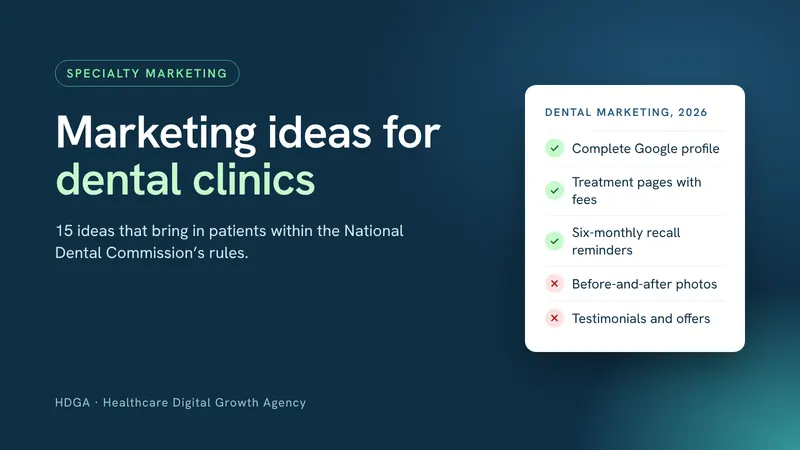
Most patients find a dentist in one of two ways: a search on Google Maps when something hurts, or a recommendation from someone they trust. Good digital marketing for dental clinics makes the first route work every time and gives the second something to point to. It does not need before-and-after galleries, smile-makeover reels or "flat 50% off" offers, which is just as well, because the dental regulator has now warned against all of them.
Here are 15 ideas that work for Indian dental practices in 2026, and the rules they need to respect. For a done-for-you programme, see our dental marketing agency page.
Dentists are regulated by the National Dental Commission, not the NMC. This guide reflects the Revised Dentists (Code of Ethics) Regulations, 2014 and the Commission's advisory of 14 October 2026. It is not legal advice.
First, the rules that shape everything
On 14 October 2026 the National Dental Commission's Ethics and Dental Registration Board warned dentists against:
- recording or broadcasting consultations and procedures
- patient testimonials and before-and-after photos
- misleading treatment claims and inaccurate health information
- self-promotional publicity
- disproportionately large signboards
The advisory points dentists to the 2014 Code of Ethics, which allows a good deal more than many practices realise:
- Advertising with decorum is allowed (regulation 8.1), as long as it involves no demeaning solicitation or false promises.
- A factual website is allowed, including your treatments and fees (8.2.9), and you may display fees in the clinic (5.7.1).
- Directory and internet listings are allowed, without claims of superiority or special skills over others (8.2.8).
- New equipment or services may be announced, without calling yourself the "best" or "first" (8.2.7).
What it rules out: soliciting patients, boasting of cases or cures, specialist titles without a recognised qualification, your photograph on signboards or letterheads, and paying or receiving anything for referrals.
With that in mind, here is what to do.
Get found
1. Make your Google Business Profile complete
For "dentist near me" and "dental clinic in [area]" searches, your Google Business Profile matters more than your website. Choose the right primary category (Dental clinic or Dentist), list every treatment you offer, keep hours accurate, including Sundays and holidays, and add real photos of the clinic, chairs, sterilisation area and waiting room. Never show identifiable patients. See Google Business Profile management.
2. Give every location its own presence
If you run more than one clinic, each needs its own Google Business Profile, its own page on your website and its own phone number, with the address written exactly the same everywhere. Chains that share one page for every branch lose the local searches each branch could win.
3. Build a page for each treatment
Patients search for treatments, not for "dental services": dental implants, root canal treatment, clear aligners, braces, crowns, wisdom tooth removal, children's dentistry. Each deserves its own page explaining what happens, how many visits it takes, recovery, risks and alternatives. Our SEO guide for doctors covers how to structure these pages, and the same approach works for dentists.
4. Publish your fees
The Code of Ethics allows fees on your website and in the clinic, and price is the first question most dental patients have. "Root canal treatment: ₹X to ₹Y, depending on the tooth and whether a crown is needed" wins more trust, and more search traffic, than "contact us for pricing". Keep figures factual and up to date.
5. Answer cost and comparison questions
Write clear answers to the questions patients type: how much an implant costs in your city, whether aligners or braces suit them better, whether a root canal hurts, how long a crown lasts. Lead with a direct answer, then the detail. This is what Google's answer boxes and AI assistants quote. Our guide to answer engine optimization shows how.
6. Keep directory listings accurate
Practo, Justdial and similar directories are allowed under regulation 8.2.8. Make sure the clinic name, address, phone, timings, dentists' qualifications and registration numbers match your Google profile exactly, and remove any line that claims superiority. See Practo for doctors for what paid listings involve.
Win the choice
7. Introduce your dentists properly
A page for each dentist with their full name, recognised degrees, State Dental Council registration number, areas of work and languages spoken. Only dentists with a recognised specialty qualification should be described as specialists (regulation 8.3.3). Patients choose a person, not a building.
8. Show the clinic, not the patients
Instead of before-and-after photos, show what reassures a nervous patient: the sterilisation process, the equipment, the waiting area, the team. A short walkthrough video of the empty clinic does more than a smile gallery and breaks no rules.
9. Teach instead of selling
Short explainers on brushing technique, gum disease warning signs, children's first dental visit, or what happens during a root canal, recorded by your dentist with diagrams or models rather than patients, build trust over time. Keep them factual and evidence-based (regulation 8.1.7), and keep your clinic's contact details out of general health education material (8.1.8).
10. Make booking easy
Online booking, a WhatsApp number that someone answers, and a phone line that is picked up within a few rings. Many dental practices lose more patients to unanswered calls than to competitors. Track missed calls and call every one back the same day.
11. Give written treatment plans
For implants, aligners and full-mouth work, a clear written plan with stages, visits and costs helps patients decide and makes it easier for them to talk it over with family. It turns a consultation into a booked treatment without any pressure.
Keep patients
12. Run a recall programme
Six-monthly check-up and cleaning reminders bring back patients you have already earned, and that is usually the cheapest growth a dental clinic has. Send reminders only to patients who agreed to receive them, keep that consent separate from consent for treatment, and make opting out easy, as the DPDP Act requires. See our DPDP Rules guide.
13. Follow up after treatment
A message the next day asking how the patient is feeling, with aftercare instructions, is good care and good marketing at the same time. Patients remember the clinic that checked on them.
14. Handle reviews within the rules
Patients can review you on Google of their own accord. Reply to every review politely, never confirm that the reviewer was your patient, and never discuss their treatment publicly. Do not repost reviews, show testimonials or offer anything in return for a review. Our healthcare reputation management page covers the details.
15. Measure booked patients, not likes
Track where each new patient came from (Google Maps, website, directory, recommendation) and what each source costs. Followers and clicks are not the goal; booked and completed treatments are. Our cost per booked patient calculator helps put numbers on it.
What to stop now
- Before-and-after photos and smile-makeover reels
- Patient testimonials, thank-you videos and reposted reviews
- Recording or live-streaming procedures
- "Best dentist in the city", "painless", "guaranteed" or "first in" claims
- Discount offers, free-camp promotions and "limited slots" messages that read as solicitation
- Your photograph on signboards or letterheads, and oversized signboards
- Paying anyone, including patients, for referrals
If you are setting up a new practice, our dental clinic setup cost calculator and Clinical Establishment Act registration guide cover the steps before marketing begins.
Common questions
Can dentists advertise in India?
Yes, with decorum. The Code of Ethics allows advertising that involves no demeaning solicitation or false promises, a factual website with fees, and directory listings without superiority claims.
Are before-and-after photos allowed for dentists?
The National Dental Commission's advisory of 14 October 2026 warns dentists against publishing before-and-after photos and patient testimonials. Remove them from your website and social media.
Can a dental clinic run Google Ads?
Advertising with decorum is allowed. Keep ads factual, with treatments, location and timings, and avoid superiority claims, guarantees and discount offers. Make sure the landing page meets the same standard.
Do the NMC advertising guidelines apply to dentists?
No. The NMC guidelines apply to medical practitioners. Dentists follow the National Dental Commission and the 2014 Code of Ethics, though the two sets of rules point in the same direction.
What to do next
Start with ideas 1, 4 and 10: a complete Google profile, published fees and booking that never misses a call. Together they win most of the patients searching near you. If you would like help with the rest, see our dental marketing agency page or book a call.