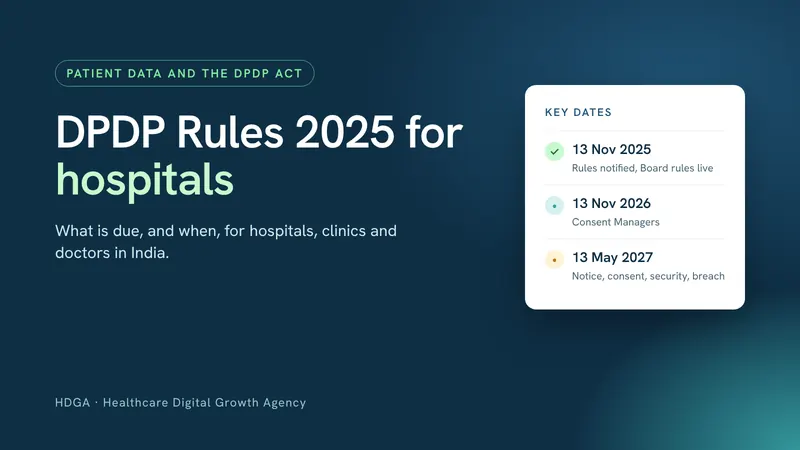
India's Digital Personal Data Protection Act, 2023 became workable on 13 November 2025, when the government notified the Digital Personal Data Protection Rules, 2025. The rules switch on in phases. Most of what affects a hospital or clinic applies from 13 May 2027, and the government has proposed bringing that forward to 13 November 2026.
Hospitals and clinic chains handle more sensitive personal data than almost any other business: medical histories, test reports, prescriptions, insurance details and children's records. Their marketing adds more: website leads, WhatsApp chats, call recordings and ad audiences. This guide sets out what the DPDP rules require, when, and what to fix first. For hands-on help, see our DPDP Act implementation service for hospitals.
This article summarises the Act and Rules as reported at the time of writing. It is not legal advice. Read the official notification from the Ministry of Electronics and Information Technology (MeitY), and talk to your lawyer about anything specific to your hospital or practice.
The DPDP rules timeline at a glance
- 13 November 2025: in force now. Definitions and the rules for the Data Protection Board of India. The Board is the regulator that will hear complaints and impose penalties.
- 13 November 2026: Consent Managers. Registered platforms that let people give, manage and withdraw consent across organisations can start operating.
- 13 May 2027: everything else. Notices, consent, security safeguards, breach reporting, retention, children's data, people's rights and the duties of large "significant" data fiduciaries.
The proposed change: in January 2026, MeitY consulted on cutting the 18-month window to 12 months, which would move the main deadline to 13 November 2026. Comments closed on 4 February 2026. As of late September 2026, no amending notification had been published. Plan as if the earlier date could apply, because a hospital needs more than a month to change its forms, systems and contracts.
Who the DPDP rules apply to in healthcare
The Act applies to anyone who processes digital personal data in India, and to paper records that are later digitised. In the Act's language:
- Data fiduciary: the organisation that decides why and how personal data is processed. Your hospital, clinic, diagnostic centre or individual practice is a data fiduciary.
- Data processor: anyone processing data on your behalf: your hospital information system vendor, lab software, CRM, call centre, WhatsApp provider, cloud host and marketing agency.
- Data principal: the patient, lead, caregiver or employee the data is about. For a child, the parent or lawful guardian acts for them.
The fiduciary stays responsible for what its processors do. If your agency leaks a lead list, the penalty exposure is yours, which is why contracts and access controls with vendors matter as much as your own systems.
What the DPDP rules require from hospitals and clinic chains
1. A clear, standalone consent notice
Before you collect personal data on the basis of consent, you must give the person a notice that stands on its own and is easy to understand. It must list the personal data you collect and the specific purpose for each item. It must also explain how to withdraw consent (as easily as it was given), how to use their rights, and how to complain to the Board.
Consent must be free, specific, informed, unconditional and given by a clear action, such as an unticked box. Pre-ticked boxes and consent hidden in the terms and conditions do not count. You cannot make treatment conditional on consenting to marketing.
2. Legitimate uses that do not need consent
Not everything needs consent. The Act allows processing without consent in defined situations. The ones that matter most in a hospital are:
- responding to a medical emergency involving a threat to life or health
- treatment and health services during an epidemic or outbreak
- safety measures during a disaster or breakdown of public order
- data a person has voluntarily shared for a specific purpose without saying they object
- compliance with a law or court order, and certain employment purposes
Routine care still runs on consent and notice. Marketing always does.
3. Reasonable security safeguards
The rules list the minimum. You need:
- encryption, masking or tokenisation of personal data
- access controls, so staff see only what their role needs
- logs and monitoring that can detect unauthorised access
- backups and continuity measures so data stays available
- logs and related data kept for at least one year
- contracts that make every processor apply the same safeguards
Failing to take reasonable security safeguards carries the highest penalty in the Act: up to ₹250 crore.
4. Breach reporting
If personal data is breached, you must:
- tell each affected person without delay, in plain language: what happened, the likely consequences, what you are doing and what they can do
- inform the Data Protection Board without delay
- send the Board a detailed report within 72 hours, unless the Board allows longer
There is no minimum size. A misdirected WhatsApp broadcast with patient names, an exposed lab report link, or a leaked lead spreadsheet can all be reportable breaches.
5. Retention and erasure
Erase personal data once the purpose is served, unless another law requires you to keep it. Clinical records are the obvious exception: medical record rules and state laws set their own retention periods. The Indian Medical Council regulations, for example, require doctors to keep indoor patient records for three years.
Marketing data has no such protection. A lead who enquired about IVF two years ago and never came in should not still be in your retargeting audience. The DPDP rules separately require you to keep processing logs for at least one year.
6. Contact details and grievance handling
Publish the business contact information of a person who can answer questions about how you process personal data. That is your Data Protection Officer, if you are required to appoint one. Build a simple way for people to request access, correction or erasure, nominate someone to act for them, and raise a grievance. Requests and grievances must be resolved within the period you publish, and no later than 90 days.
7. Children's data
Anyone under 18 is a child under the Act. Processing their data normally needs verifiable consent from a parent or lawful guardian. Tracking, behavioural monitoring and targeted advertising directed at children are prohibited.
The rules include a healthcare exemption. Clinical establishments, mental health establishments and healthcare professionals do not need verifiable parental consent when processing is limited to providing health services to the child, to the extent necessary to protect the child's health. Allied healthcare professionals get a similar exemption for carrying out a treatment or referral plan.
The exemption covers care, not marketing. A paediatric clinic's newsletter list, a vaccination-reminder campaign that doubles as promotion, or a retargeting audience built from a children's ward page is outside it.
8. Significant data fiduciaries
The government can notify large organisations as significant data fiduciaries, based on factors such as the volume and sensitivity of the data they process. A large hospital chain or health platform could qualify. Significant data fiduciaries must appoint an India-based Data Protection Officer, run a data protection impact assessment and an independent audit every year, and check that their algorithms do not put people's rights at risk.
Penalties under the DPDP Act
The Data Protection Board can impose financial penalties after an inquiry. The maximums are:
- up to ₹250 crore for failing to take reasonable security safeguards
- up to ₹200 crore for failing to report a breach, or for breaching the rules on children's data
- up to ₹150 crore for a significant data fiduciary's failure in its additional duties
- up to ₹50 crore for other breaches of the Act or Rules
The Board was being constituted through 2026; applications for members were invited in May 2026. Do not read a quiet regulator as a safe one. Patients can complain once the Board is working, and breaches surface on their own.
Where hospital marketing is most exposed
In our experience, the clinical side of most hospitals is further along than the marketing side. The common gaps are:
- Lead forms with no notice, a pre-ticked consent box, or one consent covering both the callback and future marketing.
- Tracking pixels on condition and appointment pages. A Meta or Google pixel that fires on "book an oncology consultation" shares health-related signals with a third party. Review what each tag sends, and remove it from sensitive pages unless you have clear consent.
- WhatsApp and SMS broadcasts to everyone who ever called, with no record of consent and no easy opt-out.
- Call recordings and CRM notes with symptoms and reports, open to every agent and kept forever.
- Bought or shared databases, such as health camp lists, partner leads or vendor lists, with no proof that the people agreed.
- Agencies and freelancers with admin access to ad accounts, CRMs and form inboxes, and no data processing contract.
- Review requests that quote a patient's treatment back to them by email or WhatsApp.
A DPDP rules checklist for hospitals and clinic chains
- Map your data. List every place personal data enters (forms, OPD desk, calls, WhatsApp, labs, ads) and where it goes.
- Name an owner. Appoint a person, or a Data Protection Officer, responsible for DPDP compliance, and publish their contact details.
- Rewrite your notices. One plain-language notice per purpose, in English and the local language, with withdrawal and complaint routes.
- Separate care consent from marketing consent on every form, script and app screen. Use unticked boxes.
- Audit your tags and pixels. Remove ad pixels from condition-specific and appointment pages, or limit what they send.
- Lock down access in your hospital information system, CRM and inboxes. Remove ex-staff and old agency logins.
- Sign data processing agreements with every vendor and agency that touches personal data.
- Write a breach plan with named people, templates for patient and Board notices, and a 72-hour clock.
- Set retention periods for leads, call recordings and marketing lists, and delete what is past them.
- Set up a rights and grievance process that can close requests well within 90 days, and train the front desk on it.
Common questions
When do the DPDP rules apply to my hospital?
The main obligations apply from 13 May 2027. The government has proposed moving this to 13 November 2026, so start now. The rules for the Data Protection Board are already in force.
Do small clinics and individual doctors have to comply?
Yes. The Act has no exemption based on size for clinics or doctors. A solo practice with a booking form and a WhatsApp number is a data fiduciary. The work is lighter, but the duties are the same.
Do we need patient consent to treat someone?
Treatment involves personal data, so you need a lawful basis: consent with a proper notice, or a legitimate use such as a medical emergency. Clinical consent forms under medical law are separate, and you still need them.
Can we use patient data for marketing?
Only with separate, specific consent for marketing that the patient can withdraw easily. Being a patient does not mean they agreed to promotional messages. Health content in marketing also has to follow the NMC advertising guidelines 2026.
Does the children's exemption cover our paediatric marketing?
No. It covers processing needed to provide health services to the child. Marketing to parents is ordinary processing, and targeted advertising directed at children is prohibited.
What to do next
Our free DPDP timeline infographic is ready to share with your team, and the compliance checklist includes copy-ready consent wording for lead forms.
Start with the checklist above and the two biggest risks for most hospitals: marketing consent and tracking on sensitive pages. If you want someone to map your data flows, rewrite your notices and fix your forms, pixels and CRM, see our DPDP Act implementation for hospitals and healthcare marketing compliance advisory, or book a call.