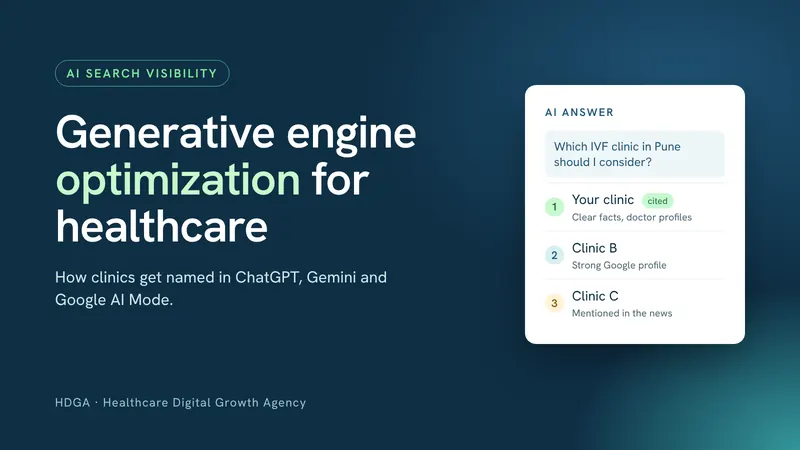
Ask ChatGPT "which hospital in Pune is good for knee replacement" and you get a short list of names, not ten blue links. Google now does something similar with AI Overviews and AI Mode, and so do Gemini and Perplexity. If your hospital is not one of the names, that patient may never reach your website.
Generative engine optimization (GEO) is the work of making your clinic or hospital one of the sources these AI systems read, trust and name. This guide explains how AI answers are put together, what makes them pick one clinic over another, and the steps that work for healthcare in India. If you would rather have it done for you, see our healthcare GEO services.
Why generative engine optimization matters for clinic chains now
AI search in India is no longer an experiment:
- ChatGPT: OpenAI's chief executive said in February 2026 that India has about 100 million weekly ChatGPT users.
- Google AI Mode: launched in India in English in June 2025, added Hindi in September 2025, and seven more Indian languages in October 2025, including Tamil, Telugu, Marathi and Bengali.
- Longer questions: Google says people ask AI Mode questions two to three times longer than normal searches. These are exactly the detailed, worried questions patients ask before choosing a doctor.
Health questions are where patients most want a direct answer. A parent asking about a child's fever at night, or a couple comparing IVF clinics, increasingly reads an AI summary first. The clinics named in that summary start the conversation; the rest have to be found some other way.
GEO, SEO and AEO: what is the difference?
- SEO (search engine optimization) gets your pages ranked in normal search results.
- AEO (answer engine optimization) gets your content chosen as the direct answer, such as a featured snippet or a voice answer. See our AEO agency page.
- GEO gets your clinic cited or named inside AI-generated answers from ChatGPT, Gemini, Perplexity, Copilot and Google's AI features.
They overlap more than the labels suggest. Most AI tools search the web before they answer, so pages that rank and are easy to quote have a head start. Google's own guidance says there are no additional requirements to appear in AI Overviews or AI Mode beyond the basics of good SEO. GEO does not replace SEO; it adds to it.
How AI answers choose which clinics to name
When someone asks an AI tool a health question, it typically:
- Rewrites the question into several searches, such as "best knee replacement surgeon Pune", "knee replacement cost Pune" and "NABH hospitals Pune orthopaedics".
- Retrieves pages from a search index. ChatGPT search, Gemini and Google's AI features each use their own search systems, so being findable by more than one matters.
- Reads and compares the pages it retrieved, looking for clear statements it can quote.
- Writes an answer and names or links the sources it relied on most.
So a clinic gets named when it is retrieved and when its pages, profiles and third-party mentions say clear, consistent, checkable things. Vague marketing copy is hard to quote. A plain sentence such as "Dr Meera Rao, MS (Ortho), has performed knee replacements at Sunrise Hospital, Pune, since 2014" is easy to quote.
What the research says works
The term GEO comes from a 2024 study by researchers at Princeton and other institutions, presented at KDD 2024, the data-mining conference. They tested changes to web pages across 10,000 queries and measured how visible each page became in AI-generated answers. The results:
- Adding quotations from credible sources improved visibility by about 40%.
- Adding statistics improved it by about 30%.
- Citing sources and making the writing clearer and more fluent each improved it by about 27 to 28%.
- Keyword stuffing, the old SEO habit, made pages slightly less visible.
The lesson for clinic chains: AI systems favour pages that sound like a careful expert, with facts, figures and sources. They do not favour pages that repeat "best hospital in Pune" twenty times.
Generative engine optimization for healthcare: nine steps
1. Let AI crawlers in
Check your robots.txt and firewall. If they block OAI-SearchBot (ChatGPT search), PerplexityBot, Bingbot or Googlebot, those tools cannot read your site. Many hospital sites block bots by accident through a security plugin or a content delivery network setting.
2. Make every doctor and location a clear entity
AI tools work with entities: a specific doctor, hospital or clinic that they can recognise across the web. For each doctor, publish a profile page with their full name, qualifications, registration number, specialities, languages, OPD timings and locations. For each location, publish a page with the exact name, address and phone number used on your Google Business Profile.
Add structured data (Physician, Hospital or MedicalClinic, and MedicalOrganization) so machines can read these facts without guessing. This also covers the disclosure rules in the NMC advertising guidelines 2026, which require name, qualifications and registration details on doctor information.
3. Answer the questions patients actually ask
List the 30 to 50 questions your front desk hears most: costs, recovery time, insurance, which doctor to see, what to bring, how long the wait is. Answer each one on a relevant page, with the answer in the first sentence or two and the detail after. This is the format AI tools lift most easily.
4. Publish facts, ranges and sources
Give cost ranges, typical hospital stay, recovery timelines and what affects them. Cite clinical guidelines, ICMR or WHO material, or peer-reviewed research where it helps. Have a qualified doctor review the page and show their name and the review date.
Stay inside the advertising rules. Facts and education are allowed. Success rates, superlatives and patient testimonials are not, so do not add them in the name of GEO.
5. Keep your Google Business Profile complete
Local AI answers lean heavily on map listings. Make sure categories, services, hours, photos and the website link are complete and accurate on Google and Bing. Our Google Business Profile management service covers this in detail.
6. Earn mentions where AI looks
AI answers often draw on third-party sources: news coverage, medical association pages, Practo and Justdial listings, Wikipedia (only where you are genuinely notable), Reddit and Quora discussions, and other credible health sites. A doctor quoted in a reputable newspaper story about monsoon infections is more likely to be named than one who is not mentioned anywhere outside their own website.
7. Keep your name, address and phone number consistent everywhere
If your hospital appears as "Sunrise Multispeciality", "Sunrise Hospital Pvt Ltd" and "Sunrise Hospital Kothrud" with three phone numbers, AI tools may treat them as different places, or trust none of them. Pick one version and use it on every listing.
8. Write for Indian languages where your patients search
With AI Mode in Hindi and seven other Indian languages, a well-written Marathi or Tamil page can be the clearest source available for a local question. Have native speakers write or check it; machine translation of medical content is risky.
9. Measure what AI says about you
Each month, ask ChatGPT, Gemini, Perplexity and Google AI Mode the 20 questions that matter most to your business, from a private browser, and record who gets named. Track referral visits from these tools in your analytics. Watch for wrong facts, such as an old address or a doctor who has left, and fix the source pages they came from.
Mistakes that keep clinic chains out of AI answers
- Blocking AI crawlers by accident, or hiding key information inside images and PDFs.
- Generic service pages with no doctor names, no prices and no specifics.
- Thin, AI-written blog posts that repeat what every other site says.
- Inconsistent clinic names, addresses or phone numbers across listings.
- Relying on an llms.txt file alone. It is a useful summary for some tools, but Google has said it does not use it, and no AI tool treats it as a ranking signal.
- Chasing claims such as "No. 1" or "best" that AI tools cannot verify and the NMC prohibits.
Common questions
Is GEO a replacement for SEO?
No. Most AI tools retrieve pages through search, so strong SEO is the base. GEO adds the work that makes your pages and profiles easy to quote and your clinic easy to recognise.
How long does generative engine optimization take?
Technical fixes such as crawler access and structured data can take effect within weeks, once the pages are re-crawled. Earning trust through better content and third-party mentions usually takes three to six months.
Can we pay to appear in ChatGPT or Gemini answers?
Organic AI answers cannot be bought. Some AI products now carry clearly labelled ads, but those are separate from the answer itself, and healthcare advertising there still has to follow NMC, ASCI and platform rules.
Does GEO work for a single-doctor clinic?
Yes, often better than for large hospitals, because local questions have fewer strong sources. A complete profile page, an accurate Google Business Profile and a handful of clearly answered patient questions can be enough to be named for your area and speciality.
What to do next
Start with three checks this week: crawler access, doctor profile pages and your Google Business Profile. Then ask the AI tools your patients use what they say about your speciality in your city, and note who they name. For a full audit and an ongoing plan, see our healthcare GEO services or book a call.