On 6 October 2026, the National Medical Commission's Ethics and Medical Registration Board issued its Guidelines on Ethical Advertising and Public Communication. They apply to every registered doctor and every hospital and clinic in India, they cover online and offline channels, and they took effect immediately, with no grace period.
If you are a doctor, a clinic owner or a hospital marketing lead, some of what you published last month may now break the rules. This guide explains what the NMC advertising guidelines 2026 allow, what they ban, and what to change first. For help reviewing your own channels, see our healthcare marketing compliance advisory.
This article summarises the guidelines as reported at the time of writing. It is not legal advice. Read the official public notice on the NMC website, and talk to your lawyer about anything specific to your practice.
The NMC advertising guidelines 2026 at a glance
- Who: every registered medical practitioner, and every hospital, clinic and medical institution.
- Where: all media, including social media, websites, Google, WhatsApp, YouTube, podcasts, print, outdoor and TV.
- What changed: "advertising" now explicitly covers sponsored posts, influencer content, platform promotion and AI-generated content with a promotional purpose.
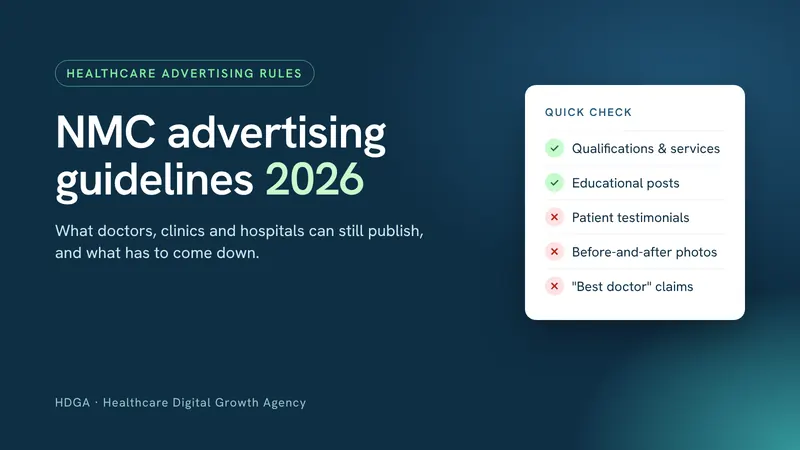
- Banned outright: guarantees, unverifiable "best" or "No. 1" claims, patient testimonials, promotional before-and-after images, fake or paid reviews, referral and per-patient fees, and inducements such as discounts and contests.
- Allowed: factual information, health education, factual fee disclosure, and a hospital directory of its doctors.
- Responsibility: doctors and hospitals remain responsible for anything an agency, influencer or platform publishes for them.
- Penalties: graded, from a warning and ethics training up to removal from the register for one to three years.
Who the guidelines apply to
The guidelines cover registered medical practitioners on the National or a State Medical Register, and hospitals, clinics and other medical institutions. Agencies, influencers and listing platforms are covered indirectly, because the doctor or hospital stays accountable for content they authorised, commissioned, sponsored or knowingly allowed.
For doctors, they are read alongside the NMC Act, 2019 and the Indian Medical Council (Professional Conduct, Etiquette and Ethics) Regulations, 2002. For hospitals and clinics, they sit alongside the Clinical Establishments Act or the relevant state law. Where a state law genuinely conflicts with the guidelines, the state law prevails.
Two kinds of communication fall outside the rules: information shared in the normal course of care without promotional intent, and government public health campaigns.
What now counts as advertising
The definition is deliberately broad. Any communication with a promotional character counts, including:
- social media posts, reels and stories
- sponsored, boosted or targeted content
- influencer and celebrity promotion
- listings and promotion on healthcare platforms
- videos, podcasts and other audio-visual content
- AI-generated or AI-assisted content
The test is purpose, not format. A video that explains how cataracts form is education. The same video that ends with "book with Dr X, the best cataract surgeon in the city" is advertising, and it breaks the rules twice.
What doctors can still do
The guidelines do not stop doctors from communicating. They stop doctors from promoting themselves and soliciting patients. These remain allowed:
- Health education and awareness content, as long as it does not promote your own practice or ask people to book with you.
- Factual announcements, such as starting a practice, moving premises, changing timings or a temporary absence.
- Stating your fees factually, as long as the figure is not used as an inducement.
- Public health talks on TV, radio or online in your own name, without promoting your employer.
- Research and case studies published in reputed journals, with patients anonymised and consent taken.
- Patient-education leaflets and greetings on national or professional days.
- Being listed in a doctor directory with your qualifications, registration and availability.
What doctors can no longer do
Reported summaries list twelve prohibited practices for doctors. In plain terms, you must not:
- Solicit patients, directly or indirectly, or use fear to create demand for tests or procedures.
- Hire a third party to market your services, or use an agency, influencer or other intermediary to do anything you could not do yourself.
- Claim results you cannot verify, such as success rates, patient numbers or "thousands of happy patients".
- Use superlatives such as "best", "No. 1" or "100% success" unless they can be objectively verified.
- Guarantee outcomes, hide risks or promote unproven treatments.
- Endorse medicines, devices, health products or any commercial product.
- Post patient cases, before-and-after images or success stories for promotion.
- Request or share patient testimonials, reviews or recommendations on social media to promote yourself.
- Pay or accept referral fees, commissions, or per-lead or per-patient fees.
- Offer discounts, limited-time offers, contests or free procedures as inducements.
- Use celebrities, influencers, patients or staff as endorsers.
- Buy followers, likes, views or reviews, or manipulate search rankings.
Point 2 matters for every doctor who works with a marketing agency. The guidelines do not stop you getting help with education content, a factual website or directory listings. They do stop you outsourcing self-promotion, and they make you answerable for whatever is published in your name.
Rules for hospitals and clinics
Hospitals and clinics get a little more room than individual doctors, but only for facts.
Allowed:
- name, address, contact details, departments and services
- facilities, equipment, diagnostic and emergency services
- accreditation status, such as NABH, stated accurately
- fees and packages stated factually
- announcements of new equipment or services, without superiority claims
- a directory of doctors with names, qualifications, specialities, registration details and availability, which the guidelines treat as patient information rather than advertising
Not allowed:
- guaranteed outcomes and comparative claims such as "best hospital in the city", unless objectively verifiable
- testimonials and before-and-after images
- fake, paid or manipulated reviews and engagement
- offers likely to push patients into care they do not need
- promotional portrayal of an individual doctor
Hoardings and billboards may carry only factual information about infrastructure and facilities. When a hospital post mentions a doctor, it must name that doctor with their qualifications and registration details. If a hospital cites a ranking or award, it must state who gave it, the method, any conditions and the date.
Social media: the rules you will meet every day
Every post a doctor publishes on electronic media must show their name, qualifications, registration status and State Medical Council or NMR registration number. Put it in your profile bio and on each post or video, not only on your website.
Before you publish, ask three questions:
- Would this post make sense if it did not mention me or my clinic? If not, it is probably promotion.
- Does it make any claim about results that I could not prove to the State Medical Council?
- Does it show or quote a patient? If so, take it down unless it is anonymised research or education with consent.
Education still works. Explaining a condition, correcting a myth or showing how to prepare for a procedure all remain allowed, and they build the trust that self-promotion used to try to buy.
Reviews, testimonials and before-and-after photos
Three rules change how most practices handle feedback:
- Patient consent does not make a testimonial acceptable. A video of a happy patient is prohibited for promotion even if the patient signed a consent form.
- Doctors must not request or share reviews for promotion on social media. Reposting a five-star review, or embedding a review widget to promote yourself, is high risk.
- Fake, paid and gated reviews are banned outright. Gating means only asking happy patients for reviews.
Patients can still leave reviews on Google and Practo on their own. Respond to them calmly, never confirm that someone was your patient, and never discuss their care in public. Our healthcare reputation management page covers how to handle negative reviews within these limits.
Promotional before-and-after images are prohibited. Anonymised clinical images in scientific or educational material, with consent, are a separate matter.
AI-generated content
The guidelines deal with AI directly:
- AI-generated promotional campaigns run for commercial interest are prohibited.
- Any permitted AI-generated promotional content must carry a mark stating that it is AI-generated.
- AI must not be used to create misleading claims about diagnosis, treatment, outcomes or qualifications.
- AI must not create or alter a patient's image, voice, testimonial or outcome, or produce endorsements that look real.
- Patient data used as an input to AI tools must be protected, in line with the IT Act and the Digital Personal Data Protection Act.
Commentators have noted that the AI clause is not perfectly clear. Until NMC clarifies it, the safe course is to have a qualified person review anything AI helped write, and not to use AI for patient-facing promotion at all.
Agencies, influencers and listing platforms
Three points apply to any outside partner:
- Responsibility does not transfer. If an agency publishes something prohibited in your name and you authorised or allowed it, you answer for it.
- No payment linked to patients. Fees for agencies, influencers or platforms must not be tied to procuring or referring individual patients. Pay-per-lead and pay-per-patient contracts need to be reviewed now.
- No paid ranking. Healthcare platforms that list doctors must follow the same norms and must not sell higher rankings.
If you work with an agency, ask for a written list of everything they publish for you, and check that their contract is based on work done, not patients delivered.
Penalties
For doctors, the State Medical Council acts after a show-cause notice and a reasoned order. Action is graded:
- First violation: warning and mandatory ethics training.
- Second violation: censure and a monetary penalty.
- Third violation: suspension of registration for three to six months.
- Serious violations: suspension for six to twelve months.
- Repeated violations: removal from the register for one to three years.
Appeals go to NMC's Ethics and Medical Registration Board within 60 days. Hospitals and clinics are dealt with under the Clinical Establishments Act or the relevant state law. A doctor who authorised a hospital's prohibited content can face separate proceedings.
A checklist for this week
Start with the channels patients see most:
- Social media profiles: add your name, qualifications and registration number to every bio.
- Recent posts: archive testimonials, before-and-after images, patient stories and "best" or "No. 1" claims.
- Website: remove superlatives, guarantees, success-rate claims, review widgets used for promotion, and patient videos.
- Google Business Profile and Practo: check descriptions and posts for claims and offers, and stop any paid or incentivised review requests.
- Ads: pause ads that use discounts, free consultations, limited-time offers or outcome claims.
- Agency and platform contracts: remove any fee linked to leads or patients, and ask for a list of everything published in your name.
- AI content: label anything AI-generated that stays up, and remove anything that shows synthetic patients or results.
- Hospital pages: make sure doctor profiles read as factual directory entries, not promotion, and that awards show who gave them and when.
- Hoardings and print: limit them to facts about facilities and services.
- Keep a record: note what you changed and when, in case a complaint is raised later.
Common questions
Do the NMC advertising guidelines 2026 have a grace period?
No grace period has been reported. They took effect on 6 October 2026.
Can doctors still post on Instagram and YouTube?
Yes. Health education, myth-busting and awareness content remain allowed, as long as they do not promote your practice or solicit patients, and every post shows your registration details.
Can a hospital still run Google Ads?
The guidelines restrict content, not channels. A hospital ad that states facts about services, facilities and fees is a different matter from one that promises outcomes, claims to be the best or offers discounts. Check every ad against the hospital rules above.
Can we still ask patients for Google reviews?
Fake, paid and gated reviews are banned, and doctors must not request or share reviews for promotion on social media. Patients can still review you of their own accord. Because the line on requesting reviews is not fully clear yet, get advice before running any review request programme.
Do the guidelines apply to AYUSH practitioners?
These guidelines come from NMC and apply to medical practitioners registered with it. AYUSH practitioners are regulated separately and follow their own advertising rules. Our AYUSH advertising compliance page covers those.
What to do next
For a quick team briefing, share our free NMC 2026 infographic, and use the healthcare marketing compliance checklist to audit your channels. Every related rule is in our healthcare marketing regulations tracker.
The safest marketing under the new rules is the kind that helps patients decide. Accurate information, clear fees, real answers to their questions and a website that makes booking easy all still work.
If you are unsure whether your website, profiles or ads comply, our NMC advertising compliance audit checks every public channel against the guidelines and gives you a prioritised list of fixes. Book a call to start.