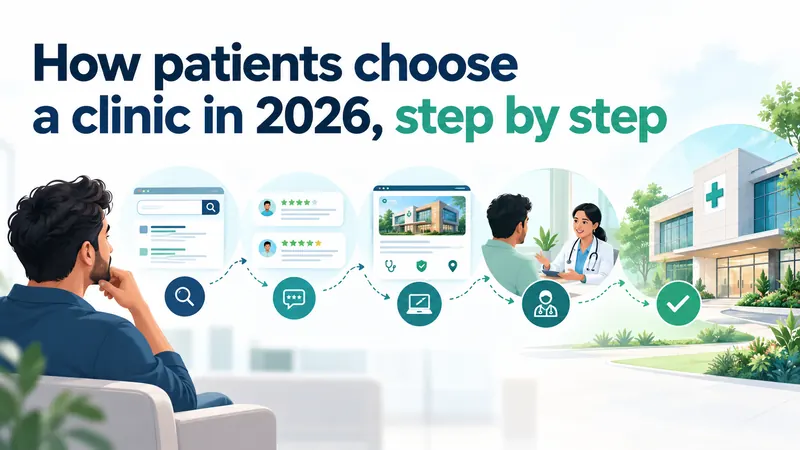
Ask a clinic owner how new patients find them and the answer is usually "word of mouth" or "Google". Both are true, and both hide what actually happens. A patient today rarely makes a decision in one place. They move through four or five checkpoints, often in a single evening on a phone, and a clinic can lose them at any one of those points.
This post walks through that path step by step, with the questions patients are asking at each stage and the one or two fixes that matter most.
Step 1: The first search
Most journeys still start with a search: a treatment ("knee replacement surgeon"), a symptom ("lower back pain that won't go away"), or a place ("dermatologist near me"). For local services, the first thing they see is usually the map with three clinics, not the list of websites below it.
What they check in the first few seconds:
- Is the clinic close enough?
- Is it open, and are the hours believable?
- What is the rating, and how many reviews are there?
What to fix first: your Google Business Profile. Correct categories, real photos, accurate hours, and the services you actually want more of listed by name. A profile with the wrong primary category can be invisible for the searches that matter most.
Step 2: The reviews
Patients read reviews differently from shoppers. They are not looking for perfection. They are looking for signs of how they will be treated: whether the doctor explained things, whether the wait was reasonable, whether billing held any surprises.
Two things work against good clinic chains here. First, happy patients rarely review unless asked. Second, a single angry review with a defensive reply from the clinic does more damage than ten mild complaints.
What to fix first: make the visit worth writing about, keep your Google profile complete so patients can find it, and never offer anything for a review. Since October 2026, the NMC's guidelines also restrict doctors from requesting reviews for promotion, so see our guide to Google reviews under NMC 2026 before running any review requests. Reply to every review, briefly and calmly, without confirming that the person was a patient or discussing their care. Our review management programme is built around exactly these two habits.
Step 3: The doctor check
For anything beyond a routine visit, patients search the doctor's name. They want to see qualifications, experience and some evidence that the doctor knows this particular problem well. Increasingly, they also ask an AI assistant: "Is Dr X good for a second opinion on IVF?" or "Which hospital in Pune is best for spine surgery?"
AI assistants build their answers from sources they consider reliable: the clinic's own website, directory listings, publications, news and reviews. If those sources are thin or contradict each other, the assistant either names someone else or gets your details wrong.
What to fix first: a clear doctor profile page on your own site, with registration, qualifications, areas of focus and consulting locations, kept consistent with every directory listing. This is the foundation of answer engine optimisation.
Step 4: The cost question
Almost every patient wants to know roughly what treatment will cost before they call. Many clinic chains avoid publishing any numbers, worried about price shopping. The result is that patients either call a competitor who does publish a range, or call you with a single question, hear "it depends", and leave.
What to fix first: an honest range on each major treatment page, with what is included and what can change the price. Patients understand that the final figure depends on their case. They mostly want to know whether they are in the right ballpark.
Step 5: The first contact
The final step is the one most clinic chains never measure. The patient calls, fills a form or sends a WhatsApp message. What happens next decides whether all the work above turns into an appointment.
Common failure points we see:
- Calls during clinic hours go unanswered because reception is busy with patients in the room.
- Form enquiries land in an inbox nobody checks until the evening.
- WhatsApp messages get a reply the next day, by which time the patient has booked elsewhere.
What to fix first: measure response time. Then shorten it. For many clinic chains, an automated WhatsApp first reply that answers logistics and offers a slot, with a handover to staff for anything clinical, makes the biggest single difference.
Where to start
If you only have time for one thing this week, search for your main treatment and your city on your phone, the way a patient would. Then ask an AI assistant the same question. Note where you appear, what the listing says, and how easy it is to book. That ten-minute exercise usually shows exactly which of the five steps is costing you patients.
If you would like a second pair of eyes on it, book a growth call and we will walk through it with you.