For years, the standard advice on how to get more Google reviews was simple: ask every happy patient, hand them a QR code, send a link on WhatsApp. For doctors in India, that advice changed on 6 October 2026.
The National Medical Commission's Guidelines on Ethical Advertising and Public Communication prohibit soliciting, buying or manipulating patient reviews, and say doctors must not request or share patient testimonials or reviews for professional promotion on social media (section 3.2, Explanation V). Some news reports summarise the rule more broadly, as a bar on requesting reviews at all. Buying or manipulating reviews, ratings, followers or likes is banned separately (section 8.1(xii)).
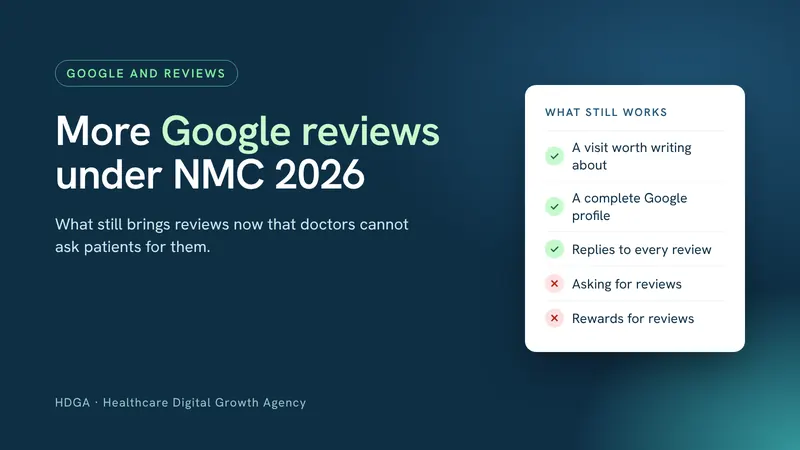
Until the NMC clarifies where a neutral request ends and promotion begins, the safe course is to stop running review-request campaigns. What clinics can do with no doubt at all is make every visit worth writing about, make the profile easy to find, and handle the reviews that come in well.
This guide reflects the guidelines as published and reported in October 2026. It is not legal advice; check edge cases with your State Medical Council.
What changed
| Before October 2026 | Safest approach now |
|---|---|
| Ask patients at the desk for a review | Do not request reviews |
| WhatsApp review links after visits | Do not send review requests |
| QR codes with "Review us on Google" | Remove "review us" requests |
| Share good reviews on Instagram | Do not share reviews or testimonials |
| Review widgets on the website | Remove them |
| Discount or free check-up for a review | Prohibited by the NMC and by Google |
| Asking only happy patients | Prohibited by the NMC and by Google |
Google's own rules already prohibited incentives for reviews, selectively asking only happy customers ("review gating"), pressuring customers on the premises, and, since April 2026, setting staff quotas for reviews or asking for reviews that name a staff member.
What still brings reviews
Patients still write reviews on their own, especially after a very good or very bad experience. The clinics with the most reviews are usually the ones patients find easily and remember well.
1. Make the visit worth writing about
The things patients mention most in clinic reviews are waiting time, how well the doctor explained things, how staff treated them, and billing. Measure your average wait, publish a standard internally, and fix the worst part of the visit first.
2. Make the profile easy to find
A complete, accurate Google Business Profile gets seen by more patients, and more patients seeing it means more reviews over time. Fill every field, keep hours current and add real photos. See our Google Business Profile setup guide.
3. Keep your name consistent everywhere
When the clinic name on your signboard, prescription pad, website and Google profile match, patients who want to write a review find the right profile instead of a duplicate or a competitor.
4. Reply to every review
Replies show future patients and reviewers that someone is listening. Keep them brief and polite, and never confirm that the reviewer was a patient or discuss their care:
Positive: "Thank you for taking the time to share your feedback. — The team at [Clinic name]"
Negative: "We are sorry to read this. We take every concern seriously. Please contact our patient relations team on [number] so we can look into it. — The team at [Clinic name]"
5. Collect private feedback to improve care
A short internal feedback form, sent to every patient and not linked to Google, tells you what to fix. Keep it separate from any request for a public review, and do not use it to filter who gets asked to review.
6. Handle complaints before they become reviews
Most one-star reviews follow an unresolved complaint. A named person who calls back unhappy patients within a day prevents many of them.
7. Report reviews that break Google's rules
Fake reviews, spam, reviews from people who were never patients, and abusive content can be reported through your Business Profile. Keep records of what you reported and when.
What to stop now
- asking patients for reviews in person, on WhatsApp, by SMS or by email
- "Review us on Google" cards, standees and QR codes
- review links in appointment reminders or invoices
- screenshots of reviews on social media or your website
- any reward, discount or free service linked to reviews
- agencies that "boost" ratings or post reviews for you
- staff targets for the number of reviews
If an agency or staff member does any of this on your behalf, the guidelines suggest you remain responsible for it.
A note on hospitals
The review provisions apply to doctors and institutions, and the guidelines are read with clinical establishment law for hospitals. Hospitals should take the cautious route and follow the same approach: no requests, no incentives, no sharing reviews in promotion.
Common questions
Can doctors ask patients for Google reviews in India?
The guidelines prohibit doctors from requesting or sharing reviews for promotion on social media, and ban fake, paid and gated reviews outright. Whether a neutral, one-off request at the clinic is allowed has not been clarified, so the safe course is not to ask until it is.
Can I put a QR code for Google reviews in my clinic?
A code asking patients to review you is a request, so the cautious course is to remove it. Your address and Google profile can still be found by anyone who searches.
Can I show my Google rating on my website?
Avoid it. Sharing reviews and ratings for promotion is restricted under the guidelines.
Can I remove a negative review?
Only Google can remove a review, and only if it breaks Google's policies. Reply politely, offer a way to resolve the concern, and report reviews that are fake or abusive.
What to do next
Walk through your clinic and your WhatsApp templates today, and remove every review request you find. Then pick one thing patients complain about and fix it this month. If you would like your profiles and reviews managed within the rules, see our Google Business Profile management and review response services, or book a call.
Sources
- NMC Guidelines on Ethical Advertising and Public Communication, 6 October 2026 (PDF via Medical Dialogues)
- The South First: NMC says no to patient testimonials, paid ads, AI promotions and guaranteed claims (October 2026)
- MedBound Times: NMC new rules for doctors on social media (8 October 2026)
- The South First: NMC bars referral commissions, restricts discounts and paid rankings (18 October 2026)
- PPC Land: Google tightens Maps review policy on staff names and quotas (17 April 2026)
- Search Engine Roundtable: Google bans discouraging negative or selectively soliciting positive reviews (6 October 2022)