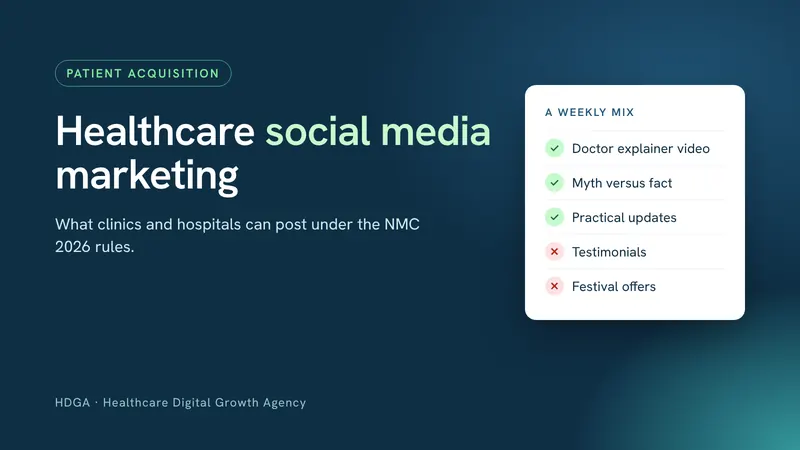
Since 6 October 2026, the posts that used to fill most clinic Instagram feeds are off limits: patient testimonials, before-and-after photos, "best doctor in the city", festival offers and thank-you reels. Many clinics have gone quiet as a result, unsure what is left.
Quite a lot is left. This guide covers healthcare social media marketing for clinics and hospitals under the NMC's 2026 guidelines: what to post, a weekly plan you can follow, what works on each platform, and what changed in paid social. For the rules in detail, see our guide to the NMC social media guidelines for doctors.
The rule of thumb
The guidelines allow doctors and hospitals to share health education, take part in public health campaigns and share objective details about their services. They prohibit testimonials, superiority claims, guarantees, offers, manipulated engagement and AI-generated fake patients or outcomes. Electronic posts must show the doctor's name, qualifications and registration number.
So: teach, inform and be useful. Do not sell yourself.
What to post
Education
- Explainers: "What happens during a root canal", "When is a headache serious?"
- Myth versus fact: common misunderstandings your doctors hear every week.
- When to see a doctor: warning signs for common conditions.
- Test explainers: what a lipid profile or HbA1c result means.
- Preparation guides: how to prepare for a colonoscopy, an MRI or surgery.
Practical information
- OPD timings, holiday hours and new doctors joining (factually).
- New services or equipment, announced plainly without "first" or "best" claims.
- How to book, what to bring, parking and directions.
- Insurance and cashless facilities.
- Package prices and charges, stated factually.
People and place
- Introductions to doctors and staff: qualifications, specialties, languages.
- Behind the scenes: sterilisation, the lab, how the pharmacy works.
- Hospital processes: admission, discharge, visiting hours.
No identifiable patients in any of these.
Public health
- Awareness days: World Heart Day, World Diabetes Day, breast cancer awareness month.
- Seasonal advice: dengue, heat stroke, air pollution, monsoon infections.
- Screening camps run as public health activity, not as patient drives.
A weekly plan
| Day | Post |
|---|---|
| Monday | Short explainer video by a doctor (60 to 90 seconds) |
| Wednesday | Myth versus fact carousel |
| Friday | Practical update or team introduction |
| Monthly | Public health day or seasonal advice; a longer video or live Q&A |
Three good posts a week, every week, beat daily posts for a month followed by silence.
Platform by platform
- Instagram: short explainer reels and carousels. Put the doctor's name, qualifications and registration number on screen or in the first line of the caption.
- YouTube: longer explainers answer the questions patients search for, and videos appear in Google results and AI answers. Add captions in English and the local language.
- Facebook: reaches older patients and families; good for practical updates and health talks.
- LinkedIn: for doctors' professional reputation, hospital news, hiring and referrals from other doctors.
- WhatsApp: for patients who opted in, with appointment and health updates. Consent rules apply under the DPDP Act; see our DPDP consent form templates.
What to stop posting
- testimonials, thank-you videos and screenshots of reviews
- before-and-after photos
- "best", "No. 1", "most trusted", "painless", "guaranteed"
- festival discounts, free consultations as bait, "limited slots"
- influencer and celebrity endorsements
- AI-made images or voices without a clear AI label, and any AI-made patient
See our explainer on the NMC AI-generated content rule.
Comments and messages
- Reply to general questions with general information and an invitation to book.
- Never diagnose or prescribe in comments or DMs.
- Never confirm that someone is a patient.
- Move anything personal to a private, secure channel.
Paid social has changed too
Boosted posts follow the same NMC rules as organic posts. On the platform side, Meta introduced limits in early 2025 on health and wellness advertisers whose ads relate to medical conditions or patient relationships, restricting optimisation for lower-funnel events such as appointment bookings, and in 2026 it flagged custom audiences and conversions whose names implied sensitive health traits. Meta's policies also bar ad copy that implies you know a viewer's medical condition, such as "Struggling with your diabetes?". Check your Ads Manager for restrictions before planning a campaign.
How to measure it
Followers and likes are not the goal. Track:
- profile visits and link clicks to booking pages
- calls and WhatsApp messages that mention social media
- questions patients ask at the desk about a post
- new patients who say they found you on social media
Common questions
Can clinics still use Instagram under the NMC 2026 rules?
Yes, for education, practical information and factual updates, with the doctor's details on posts. Testimonials, offers and superiority claims are not allowed.
Can we post photos of our team and clinic?
Yes. Photos of staff, facilities and equipment are fine. Avoid photos where patients can be identified.
Can we run Facebook and Instagram ads?
Yes, within the same NMC limits, and subject to Meta's health advertising policies.
How often should a clinic post?
Three times a week is a sustainable pace for most clinics. Consistency matters more than volume.
What to do next
Delete or archive old testimonial and offer posts this week, then plan four weeks of content using the weekly plan above. If you would like a team to run it, see our healthcare content marketing and video marketing services, or book a call.