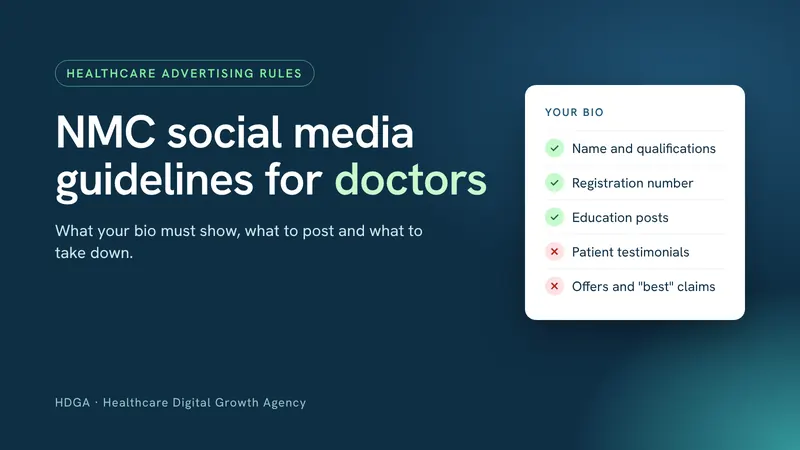
The National Medical Commission's Guidelines on Ethical Advertising and Public Communication, issued on 6 October 2026, apply to every post, reel, video and story a doctor publishes. Most doctors on social media now have the same three questions: what has to be in my profile, what can I still post, and what do I need to take down?
This is a practical, platform-by-platform guide to the NMC social media guidelines for doctors. For the full rules, including hospitals, penalties and agencies, read our NMC advertising guidelines 2026 explainer.
This article is based on reported summaries of the NMC notice at the time of writing. It is not legal advice. Read the official notice on the NMC website, and check anything specific to your practice with your State Medical Council or a lawyer. Where the guidelines are silent, we say so and give our own recommendation.
The NMC social media rules in five lines
- Disclose who you are on every electronic post: name, qualifications, registration status and State Medical Register or National Medical Register number.
- Educate, do not promote yourself. Health education is allowed. Soliciting patients and promoting your own practice are not.
- No testimonials, patient success stories or promotional before-and-after images, even with the patient's consent.
- No claims you cannot prove: "best", "No. 1", "100% success", guarantees and patient counts.
- You answer for everything published in your name, including by your team, an agency, an influencer or an AI tool.
Step 1: Fix your profile and bio
Your profile is the first place a complaint will look. On every platform, the bio or "About" section should show:
- your full name, as registered
- your qualifications, such as MBBS, MD (Dermatology)
- your registration number and the council that issued it
- your speciality and the city you practise in, stated factually
A simple format that fits most bios:
Dr [Full name] | MBBS, MD ([Speciality]) | Reg. No. [number], [State] Medical Council | [Speciality], [City]
Remove anything that reads as a claim: "top-rated", "trusted by 10,000 patients", "award-winning", "best in Pune". If you cite an award, the guidelines expect you to state who gave it, how, and when. The simpler course is to leave awards out of your bio.
Step 2: Put the disclosure on every post
The reported text says every electronic post should carry your identity and registration details, and that captions, descriptions, hashtags, on-screen text and titles all count. In practice:
- Instagram and Facebook posts: add a closing line to the caption with your name, qualifications and registration number. Save it as a text shortcut on your phone.
- Reels, Shorts and YouTube videos: show the details as on-screen text in the first few seconds, and repeat them in the description.
- YouTube channel: put the full disclosure in the channel's About section and in every video description.
- LinkedIn: include qualifications and registration in your headline or About section, and in articles you publish.
- X (Twitter) and Threads: the bio must carry it. For short posts, a pinned post with your full details helps.
- Podcasts and live sessions: state your name, qualifications and registration at the start, and in the episode notes.
Step 3: Post education, not promotion
Education still works, and it is what builds trust anyway. Content that stays on the right side of the line includes:
- explaining a condition, its warning signs and when to see a doctor
- correcting a common myth, with sources
- how to prepare for a test, procedure or surgery
- seasonal health advice, such as dengue prevention in the monsoon
- what a new guideline or study means for patients
- factual announcements: a new practice, a change of address or timings, a temporary absence
A useful test before you post: would this still make sense if it did not mention you or your clinic? If the answer is no, it is probably promotion.
Rewriting common posts
- Before: "Pune's best hair transplant surgeon. 5,000+ happy patients. DM to book!" After: "Hair fall three months after a fever is common and usually temporary. Here is what is normal, and the signs that mean you should see a dermatologist."
- Before: "Diwali offer: 20% off all laser sessions this week only." After: remove it. Discounts and limited-time offers are inducements under the guidelines.
- Before: a video of a patient thanking you after surgery. After: an animated or whiteboard explainer of how the surgery works and what recovery looks like, with no patient in it.
- Before: "100% success in knee replacement." After: "What to expect in the first six weeks after a knee replacement," with a realistic recovery timeline.
Step 4: Know what to avoid on every platform
- Patient testimonials, thank-you messages, reviews or "patient stories", reposted or quoted.
- Before-and-after photos used for promotion.
- Superlatives, rankings, success rates and patient counts you cannot verify.
- Discounts, cashback, coupons, contests, free camps used to bring in patients, and "limited slots" urgency.
- Endorsing medicines, devices, supplements, skincare or any commercial product, including paid brand collaborations.
- Paid influencers or celebrities promoting you.
- Bought followers, likes, views or reviews.
- Fear-based posts that push people towards tests or procedures they may not need.
Comments, DMs and online advice
The reported guidelines do not set specific rules for comments and direct messages. These are our recommendations, based on the guidelines' principles and existing medical ethics:
- Do not give individual medical advice in public comments. Reply with general information and suggest seeing a doctor.
- Never confirm that someone is your patient, and never discuss anyone's care in public, even if they post about it first.
- Treat DMs carefully. A detailed diagnosis in Instagram DMs is a teleconsultation. If you consult remotely, follow the Telemedicine Practice Guidelines: identify the patient, take consent, keep records, and know what can and cannot be prescribed remotely.
- Do not use DMs or comments to sell. Replying "DM us to book" under an education post turns it into solicitation.
Boosted posts and paid promotion
The guidelines treat sponsored, targeted and influencer-led content as advertising, so every boosted post must meet the rules in full. For individual doctors, who are not allowed to promote themselves, we recommend not boosting posts about your own practice at all. Boosting a public health message is lower risk, but it must still carry your disclosure and make no claims.
AI tools and your social media
If you use AI to draft captions, scripts or images, review every one yourself before it goes out. The guidelines prohibit AI-generated promotional campaigns for commercial interest, and require AI-generated promotional content to be labelled. AI must never create or alter a patient's image, voice, testimonial or outcome, and never invent qualifications or results.
Working with a team or agency
Responsibility does not move to your social media manager or agency. If they publish something prohibited in your name and you allowed it, you answer for it. Some reported summaries also say doctors may not hire third parties to market their services, so keep any outside help to education content and factual information. Good practice:
- approve every post in writing before it goes live
- keep a log of what was published, when, and who approved it
- make sure fees are for work done, never per lead or per patient
- give the agency this guide, and ask them to confirm they follow it
Clean up your old posts this week
- Bios: update every platform with your name, qualifications and registration number. Remove claims and awards.
- Pinned posts and highlights: these get the most views. Check them first.
- Testimonials and patient videos: archive or delete them, including reposted stories saved as highlights.
- Before-and-after images: archive any used for promotion.
- Offers and discounts: remove old festival offers, camps and "limited slots" posts.
- Captions: search your own profile for "best", "No. 1", "100%", "guaranteed" and "happy patients", and edit or archive those posts.
- Link-in-bio pages: check that the website and booking pages they lead to follow the same rules.
If you have years of content, our NMC doctor advertising compliance audit reviews every channel and gives you a list of what to edit or archive.
Common questions
Do I need my registration number on every reel?
Reported summaries say every electronic post should carry it, and that on-screen text and captions count. The safe course is to show it on screen in the first few seconds and include it in the caption.
Can I still share a patient's thank-you message?
No, not for promotion. The guidelines prohibit requesting or sharing patient testimonials to promote yourself on social media, and consent does not change that.
Can I post surgery or procedure videos?
Only as genuine education, with the patient anonymised, consent documented and nothing that promotes you or your results. A video titled "watch our amazing results" is promotion.
Can I mention my clinic address or timings?
Factual practice information is allowed, such as announcing a new location or changed timings. Avoid turning education posts into calls to book.
Can I appear on a podcast or someone else's channel?
Yes, if you speak in your own name, give education and do not promote your practice or endorse products. Ask the host to include your qualifications and registration details in the description.
What to do next
The compliance checklist has a copy-ready bio line and post disclosure line you can paste straight in.
Update your bios today, add the disclosure line to your next post, and spend an hour this week archiving old testimonials and offers. If you would like a full review of your social media against the NMC guidelines, see our NMC compliance audit and healthcare marketing compliance advisory, or book a call.
Sources
- The South First: Doctors on Instagram? NMC says no to patient testimonials, paid ads, AI promotions and "guaranteed" claims
- NexaFlow: NMC's new advertising guidelines for doctors (October 2026)
- HealthUs: NMC guidelines on ethical advertising 2026
- Ministry of Health and Family Welfare: Telemedicine Practice Guidelines
- National Medical Commission