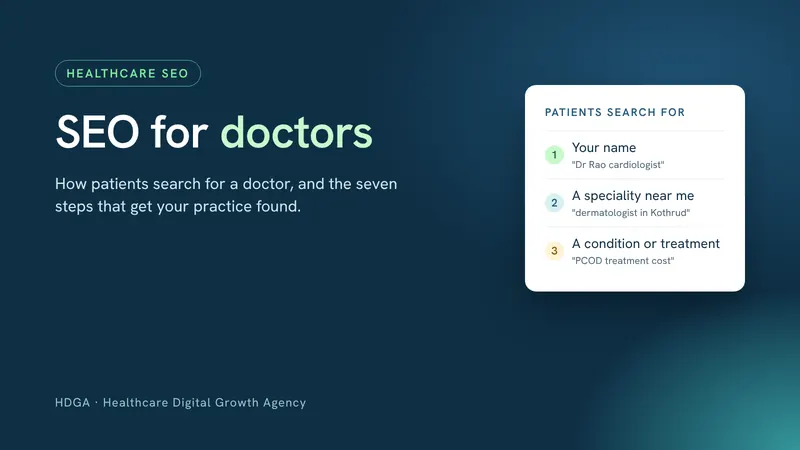
Most patients now meet their doctor on Google before they meet them in person. They search a symptom, a speciality "near me", or the doctor's name after a referral, and decide in a few seconds whether to call. SEO for doctors is the work of making sure your practice shows up in those moments with accurate, trustworthy information.
This guide is written for doctors, practice managers and clinic chains in India. It covers how patients search, the seven steps that matter most, and what the NMC rules mean for your SEO. If you would rather have it done for you, see our healthcare SEO services.
How patients search for a doctor
Patients search in three distinct ways, and each needs different work:
- Name searches: "Dr Anjali Rao cardiologist". Someone was referred to you and wants to check you out. They should find your profile, your clinic, your timings and your reviews, not an outdated listing with the wrong phone number.
- Local searches: "dermatologist near me", "paediatrician in Kothrud". The results are dominated by the Google Maps panel, so your Google Business Profile matters more than your website here.
- Condition and treatment searches: "knee pain when climbing stairs", "PCOD treatment cost in Pune". These are won by clear, medically sound pages that answer the question.
A solo practice usually wins the first two quickly. The third takes longer, but it is where new patients who have never heard of you come from. Our guide to how patients choose a clinic covers the full journey.
SEO for doctors in seven steps
1. Get your Google Business Profile right
For local searches, your Google Business Profile is the most important page you have. Google allows individual practitioners to have their own profile. In a multi-doctor practice, each doctor can have one alongside the practice's profile. If you are the only doctor at the clinic, Google asks for one shared profile, named in the format "Clinic name: Dr Your Name". Check that:
- the name is your real name or the clinic's real name, with no keywords added (adding "best dermatologist" to the name breaks Google's rules and can get the profile suspended)
- the primary category is precise, such as "Dermatologist" rather than "Doctor"
- the address, phone number and timings match your website and signboard exactly
- services, photos of the clinic and a short factual description are filled in
Our Google Business Profile management service handles this for single practices and clinic chains.
2. Build a doctor profile page that answers the basics
Every doctor needs a page on the practice website with:
- full name, qualifications and registration number with the issuing council, which the NMC advertising guidelines 2026 expect on doctor information
- specialities and the conditions and procedures you treat
- clinic locations, OPD days and timings, and how to book
- languages spoken, and hospital affiliations stated factually
Add structured data (the Physician schema type) so search engines and AI tools can read these facts reliably.
3. Create one page for each treatment or condition
A single "Services" page listing twenty treatments rarely ranks for any of them. Give each main treatment or condition its own page: what it is, who it is for, how it is done, recovery, risks, a realistic cost range, and when to see a doctor. Write it in plain language, have the treating doctor review it, and show their name and the review date.
Google treats health content as "your money or your life" material and looks hard for signs of real expertise. A page reviewed by a named, qualified doctor beats a longer page written by a copywriter.
4. Answer the questions patients actually ask
Ask your front desk for the 30 questions they hear most: costs, insurance, how long the wait is, whether a procedure hurts, what to bring. Answer each one clearly on the relevant page. These answers win "People also ask" boxes and are what AI tools quote. See our guide to generative engine optimization for healthcare for how this carries into ChatGPT and Gemini.
5. Keep your listings consistent
Patients and search engines cross-check you across Google, Practo, Justdial, hospital websites and medical directories. Use exactly the same name, address and phone number everywhere. Close duplicate listings, and update every listing when you move or change your timings.
6. Earn reviews the right way
Reviews influence both rankings and choices. Under the NMC 2026 guidelines, doctors must not buy, fake or incentivise reviews, and must not request or share patient reviews to promote themselves on social media. Patients remain free to review you on Google and Practo on their own. Respond to reviews politely, never confirm that someone was your patient, and never discuss anyone's care in public. Our reputation management page explains how to handle negative reviews within these limits.
7. Fix the technical basics
- Make the site fast on a mid-range Android phone on mobile data. Most patients search from one.
- Use HTTPS, a clear menu, and one page per topic with no duplicate pages.
- Set up Google Search Console to see which searches bring patients and which pages have errors.
- Make phone numbers tappable and booking forms short.
SEO for clinic chains and multi-doctor practices
Chains and group practices need a structure that scales:
- One location page per clinic, with its own address, map, timings, doctors and services, linked to that clinic's Google Business Profile.
- One profile page per doctor, linked to every location where they consult.
- Central treatment pages that link out to the locations offering each treatment.
- One owner for listings, so a change in timings at one branch is updated everywhere the same week.
What not to do
Some common SEO tactics now also break medical advertising rules:
- superlatives in titles or page names, such as "best", "No. 1" or "top-rated", unless objectively verifiable
- patient testimonials, success stories and promotional before-and-after photos on your pages
- bought reviews, review gating (only asking happy patients), or paying per review
- fake locations or virtual offices created to rank in other areas
- AI-written health pages published without review by a qualified doctor
How long SEO takes for a doctor
Name searches and Google Business Profile fixes usually show results within weeks. Local rankings typically improve over two to four months. Treatment and condition pages take three to six months to build traffic, depending on the speciality and city. Measure booked appointments from search, not just rankings: calls from your Business Profile, website bookings and "how did you hear about us" at the front desk.
Common questions
Do I need a website if I have a Google Business Profile?
A profile alone can bring calls for local searches. A website lets you rank for treatment and condition searches, gives AI tools something to quote, and makes your profile more credible. For most doctors, both together work far better than either alone.
Can I do SEO myself?
Yes, the first steps: claim and complete your Google Business Profile, check your listings and write a proper doctor profile page. Treatment pages and technical work take more time, which is where most doctors bring in help.
Should every doctor in my clinic have a separate page?
Yes. Patients search for doctors by name, and each doctor needs a page with their qualifications, registration details and timings.
Is SEO allowed under the NMC guidelines?
Making accurate information about your practice easy to find is not prohibited. What the guidelines restrict is self-promotion and misleading claims, so keep pages factual and educational, and avoid testimonials and superlatives.
What to do next
This week, check your Google Business Profile, search your own name and fix any wrong listings, and list the ten treatments you most want to be found for. If you want a full SEO plan for your practice or clinic chain, see our healthcare SEO services or book a call.