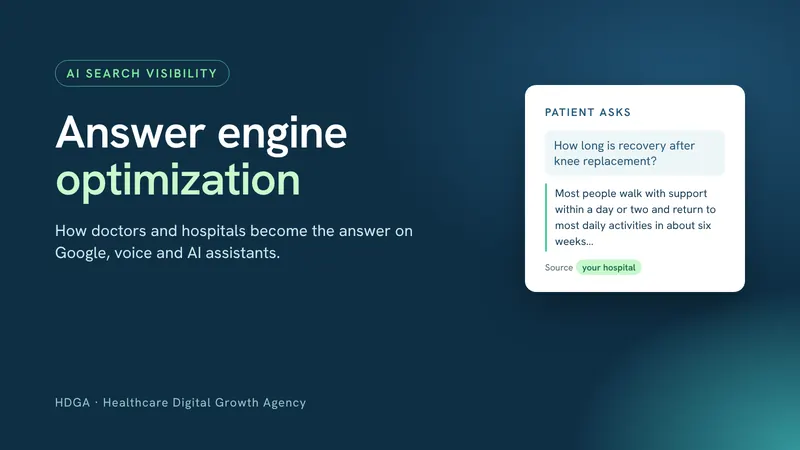
Patients do not search in keywords any more. They ask questions: "how long is recovery after knee replacement", "is laser hair removal safe in summer", "what does a thyroid test show". Google, Gemini, ChatGPT and voice assistants increasingly answer those questions directly, quoting one or two sources. Answer engine optimization (AEO) is the work of making your hospital or practice the source they quote.
This guide is for doctors, hospital marketing teams and clinic chains in India. It covers where answers appear, what changed in 2026, and the steps that get your pages chosen. If you want it done for you, see our healthcare AEO agency page.
AEO, SEO and GEO: how they fit together
- SEO gets your pages ranked. See our SEO guide for doctors.
- AEO gets a specific passage on your page chosen as the answer: a featured snippet, a People Also Ask box, a voice reply or a line in an AI Overview.
- GEO gets your hospital named and cited inside AI-generated answers. See our guide to generative engine optimization for healthcare.
They share one foundation: clear, trustworthy answers on well-built pages. AEO is about the shape of the answer itself.
Where patients see answers
- Featured snippets: the boxed answer at the top of Google, usually a paragraph, list or table lifted from one page.
- People Also Ask: expandable questions, each answered by a snippet from a different page.
- AI Overviews and AI Mode: Google's AI-written summaries, with links to the pages they drew on.
- Voice assistants: Gemini and Google Assistant on Android phones, and smart speakers, which usually read out a single answer.
- Chat assistants: ChatGPT, Gemini and Perplexity, which quote and link sources for health questions.
In every case, one short passage is chosen and the rest of the page is a supporting reference. Your job is to write that passage well.
What changed in 2026
Two shortcuts that used to work no longer do:
- FAQ rich results are gone. Google limited FAQ rich results to authoritative government and health websites in 2023, and stopped showing them altogether on 7 May 2026. FAQPage markup does no harm and remains valid, but it no longer produces the expandable questions under your search listing.
- HowTo rich results were retired in 2023.
So AEO now depends almost entirely on what the answer says and how the page is structured, not on markup tricks.
Answer engine optimization in eight steps
1. Collect the questions patients really ask
Start with your own sources, not keyword tools:
- your front desk and call centre: list the 50 questions they hear most
- WhatsApp enquiries and website forms
- Google Search Console: filter queries containing "how", "what", "why", "cost", "can" and "is"
- the People Also Ask boxes for your main treatments
- questions doctors hear in OPD that patients were embarrassed to search
Group them by treatment or condition. Each group becomes a page or a section.
2. Put the answer first
Under a heading phrased as the question, answer it in the first one or two sentences, in about 40 to 60 words. Then explain, qualify and add detail. Search engines and AI tools look for a passage that answers the question on its own.
Weak: "Knee replacement is a common procedure performed by our experienced orthopaedic team using advanced technology…"
Strong: "Most people walk with support within a day or two of a knee replacement, return to most daily activities in about six weeks, and feel the full benefit over several months to a year. Recovery depends on age, fitness and how closely you follow physiotherapy."
The strong version answers the question, gives realistic ranges and makes no promises.
3. Match the format to the question
- "What is…" questions: a one-sentence definition, then detail.
- "How to…" or "what happens during…": numbered steps.
- "Which is better…": a short comparison, point by point, with a balanced conclusion.
- "How much does… cost": a realistic range, what is included, and what changes the price. "Between ₹X and ₹Y in Pune, depending on…" is far more useful than "contact us for pricing".
4. Give every important topic a proper home
One page per treatment or condition, with question-led sections, beats a single FAQ page with 80 questions. Keep a short questions section on each treatment page for the long tail.
5. Show who wrote and reviewed the answer
Health answers are judged on trust. Name the doctor who reviewed each page, with qualifications, registration details and the review date, and link to their profile. This is also what the NMC advertising guidelines 2026 expect of doctor information.
6. Keep answers educational, not promotional
An answer that says "our success rate is the highest in Mumbai" will not be chosen, and it breaks the NMC rules. Answer the patient's question honestly, including risks and alternatives. Mention your hospital in the supporting text, not in the answer itself.
7. Use structured data that still helps
Rich results are fewer, but structured data still helps search engines and AI tools understand who you are. Mark up doctors (Physician), facilities (Hospital or MedicalClinic), articles (Article or MedicalWebPage) and your organisation. Keep FAQPage markup if you have it; just don't expect it to change how your listing looks on Google.
8. Write for voice and Indian languages
Voice questions are longer and more conversational, often in Hindi or a regional language. Pages written natively in Marathi, Tamil, Telugu or Bengali, with clear question-and-answer sections, have far less competition than English pages.
How to measure AEO
- Search Console: track impressions and clicks for question-style queries, and for pages you have restructured.
- Snippet checks: search your top 30 questions monthly from a private window and note who owns the snippet and People Also Ask answers.
- AI answer checks: ask Gemini, ChatGPT and Google AI Mode the same questions and record which sources they cite.
- Bookings: watch calls and enquiries from treatment pages. Being the answer should lead to more of the right patients, not just more traffic.
Mistakes to avoid
- Burying the answer under three paragraphs of introduction.
- Answering a different question from the one in the heading.
- "Contact us to know more" instead of an actual answer.
- Copying answers from other sites, or publishing AI-written answers without a doctor's review.
- Promotional claims, testimonials or guarantees inside answers.
Common questions
Is AEO different from SEO?
AEO is part of good SEO, with a narrower goal: making one passage on your page the chosen answer. The page still needs to rank and be trusted, which is SEO's job.
Does FAQ schema still help in 2026?
Not for how your listing looks on Google, since FAQ rich results stopped appearing in May 2026. The markup does no harm and may still help other systems understand your page, but the content of the answers matters far more.
How long should an answer be?
Lead with 40 to 60 words that answer the question on their own, then add as much detail as the topic needs.
Can a small clinic compete with large hospital websites?
Yes, especially for local and specific questions, such as cost in your city, a particular procedure or questions in a regional language. Large sites often answer general questions only.
What to do next
List the 20 questions your patients ask most, check who answers them on Google today, and rewrite your relevant pages answer-first. For a full AEO and GEO plan for your hospital or clinic chain, see our healthcare AEO agency and healthcare GEO services, or book a call.