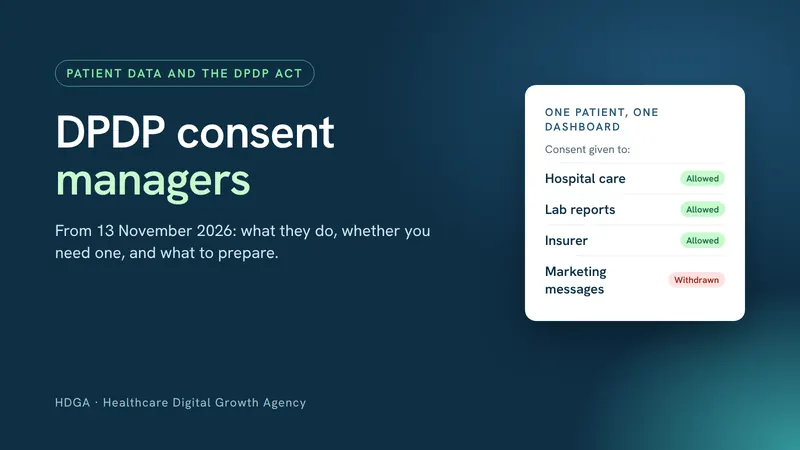
From 13 November 2026, companies can register with the Data Protection Board of India as consent managers under the DPDP Rules. It is the second phase of the rules, six months before most other duties apply, and it has caused some confusion in healthcare. Do hospitals now need to sign up with a consent manager? What happens when a patient withdraws consent through one?
This guide explains what a DPDP consent manager is, what the rules require of them, what changes for hospitals and clinic chains, and what to prepare. For the full DPDP picture, read our guide to the DPDP Rules for hospitals and clinic chains.
This article summarises the DPDP Act and Rules as reported at the time of writing. It is not legal advice. Check the official MeitY notification and take legal advice for your organisation.
What is a consent manager?
A consent manager is a company registered with the Data Protection Board that gives people one place to give, manage, review and withdraw consent across many organisations. Think of it as a dashboard for a patient's permissions: which hospital, lab, insurer or app they have allowed to use their data, for what purpose, and a single button to withdraw.
Consent managers can also move data between organisations at a person's request. The rules require them to do this without being able to read the data themselves, acting like a sealed courier.
What the DPDP rules require of consent managers
To register with the Board, a consent manager must, among other conditions:
- be a company incorporated in India, with adequate technical, operational and financial capacity
- have a net worth of at least ₹2 crore
- have directors and senior managers of good reputation, and conflict-of-interest safeguards written into its constitution
- get independent certification that its platform meets the Board's standards
Once registered, it must:
- act in a fiduciary capacity towards the people it serves, not the organisations that pay it
- run an accessible website or app where withdrawing consent is as easy as giving it
- not be able to read the personal data that passes through it
- keep records of notices, consents and data sharing for at least seven years
- handle grievances, respond within the published time limit, and submit to audits
- not subcontract its obligations, and get Board approval for any change of control
- publish details of its promoters, directors and significant shareholders
Do hospitals have to use a consent manager?
No. The rules do not require hospitals, clinics or labs to use a consent manager. You can collect and manage consent yourself, as long as your notices, consent, withdrawal and records meet the Act's standards. Most hospitals will do exactly that.
What changes is on the patient's side. A patient may choose to manage their consents through a registered consent manager. If they do, consent given or withdrawn that way is meant to count. In practice, that means your systems need to be able to receive a consent decision from outside and act on it, especially a withdrawal.
The ABDM consent manager is something different
Hospitals using the Ayushman Bharat Digital Mission (ABDM) already know the term "consent manager". ABDM's consent manager is an electronic system that lets patients approve the sharing of health records between ABDM-linked providers. It is not the same as a DPDP consent manager registered with the Data Protection Board, and as of October 2026 it had not been announced whether ABDM's infrastructure would register under the DPDP Rules.
Two practical points follow:
- ABDM integration does not replace your DPDP notice and consent. You still need your own notices and consent records under the DPDP Act.
- Keep the two flows separate in your documentation, so staff and auditors can tell which consent covers record sharing under ABDM and which covers your own processing.
When will consent managers actually appear?
The legal start date is 13 November 2026, but registration needs a functioning Data Protection Board. MeitY invited applications for the Board's chairperson and members in May 2026, and as of mid-October 2026 no appointments had been reported. Expect registered consent managers to arrive gradually after the Board is constituted, not on day one.
Do not take that as a reason to wait. The government has also proposed bringing the main DPDP deadline forward from 13 May 2027 to 13 November 2026, which would put consent, notice and withdrawal duties on the same date. See our DPDP timeline infographic.
What hospitals and clinic chains should prepare
Whether or not your patients ever use a consent manager, the same groundwork is needed:
- Map every consent you collect. Appointment forms, OPD registration, WhatsApp opt-ins, call-centre scripts, apps, health camps and ad lead forms.
- Separate purposes. Consent for care, for reminders, for marketing and for sharing with partners should be recorded separately, so one can be withdrawn without the others.
- Keep consent records you can prove. Who consented, to what notice version, when and through which channel.
- Make withdrawal travel. When a patient withdraws marketing consent, it must reach your CRM, WhatsApp and SMS tools, email lists and ad audiences. This is where most hospitals fail today.
- Ask your vendors about consent manager support. Your hospital information system, CRM and patient app vendors should be able to accept consent decisions from external platforms in future.
- Centralise across branches. Clinic chains need one consent register, not a separate spreadsheet per location.
- Set up grievance handling. A named person, a published channel and a response well within 90 days.
Our healthcare marketing compliance checklist includes ready-to-adapt consent wording for lead forms and WhatsApp.
What this means for healthcare marketing
Consent managers will make withdrawal easier, and easier withdrawal means more of it. For marketing teams, that means:
- Suppression lists become critical. A withdrawn patient who still gets a WhatsApp offer two weeks later is a clear breach.
- Marketing lists will shrink, and get better. People who stay opted in actually want to hear from you.
- Retargeting needs care. Uploading contact lists to Meta or Google for ad audiences is processing that needs a lawful basis, and withdrawals must remove people from those audiences too.
Common questions
Is a consent manager mandatory for hospitals?
No. Using a consent manager is optional for hospitals and clinics. You must still meet the DPDP standards for notice, consent, withdrawal and records yourself.
When do consent managers start?
The DPDP Rules allow consent managers to register from 13 November 2026. Registration depends on the Data Protection Board being constituted, which had not been reported as of mid-October 2026.
Can a consent manager see our patients' health records?
No. The rules require a consent manager to be unable to read the personal data that passes through its platform. It handles the permission, not the content.
Is the ABDM consent manager a DPDP consent manager?
Not as of October 2026. ABDM's consent manager is a separate system for sharing health records between ABDM-linked providers. Whether it will register under the DPDP Rules has not been announced.
Can a hospital become a consent manager?
Only by setting up a separate, registered company that meets the conditions, including ₹2 crore net worth, independent certification and a fiduciary duty to patients that rules out conflicts of interest. It is not a realistic route for most providers.
What to do next
Start with the consent map and the withdrawal test: withdraw marketing consent for a test patient and see how long it takes to reach every system. If you want help building DPDP-ready consent flows across your forms, CRM and WhatsApp, see our DPDP Act implementation for hospitals, check every related rule in our healthcare marketing regulations tracker, or book a call.