A dental clinic earns most of its revenue from a handful of treatments, such as implants, aligners, root canals, crowns and braces, and patients search for each of them differently. Dental SEO is the work of making sure that when someone near you searches for one of those treatments, your clinic is what they find, and that the page they land on answers their question well enough to book.
This guide covers the keyword map, the page structure, the Google profile setup and the trust signals that matter for dentists in India. For broader ideas, including recalls and reviews, see our dental clinic marketing ideas. For SEO for doctors in general, see our SEO guide for doctors.
Start with how patients search
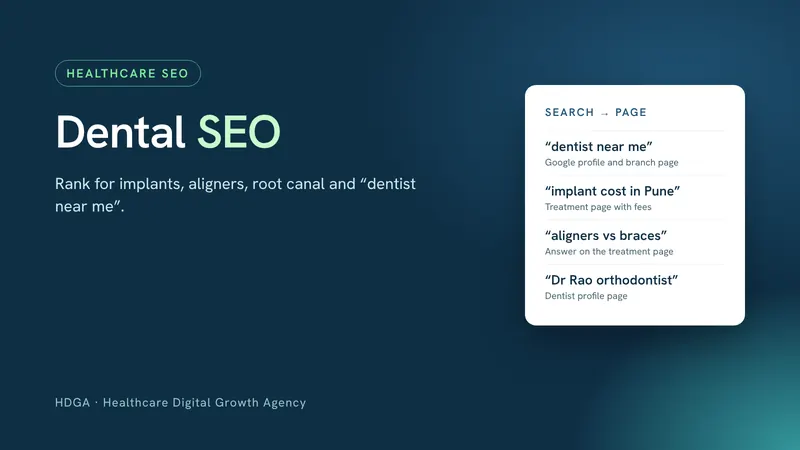
Dental searches fall into four groups, and each needs a different page:
| Search type | Examples | Best landing page |
|---|---|---|
| Urgent and local | "dentist near me", "tooth pain dentist open now", "emergency dentist Andheri" | Google Business Profile and branch page |
| Treatment and cost | "dental implant cost in Pune", "root canal price", "clear aligners cost India" | Treatment page with fees |
| Comparison and worry | "aligners vs braces", "does root canal hurt", "implant or bridge" | Treatment page section or guide |
| Specific dentist | "Dr [name] orthodontist", "[clinic name] reviews" | Dentist profile page and Google profile |
The urgent and local searches decide who gets the walk-ins. The treatment and cost searches decide who gets the high-value cases. Most clinics only plan for the first group.
Build the keyword map
List your top treatments by revenue and capacity, then match each to the searches patients actually use. A typical map for a three-chair clinic:
- Dental implants: dental implant cost, single tooth implant, full mouth implants, implant dentist near me
- Clear aligners: aligners cost, invisible braces, aligners vs braces
- Root canal treatment: root canal cost, root canal near me, single sitting root canal
- Crowns and bridges: zirconia crown cost, cap for tooth
- Braces: braces cost, metal vs ceramic braces, braces for adults
- Children's dentistry: kids dentist near me, child tooth cavity
- Emergency: tooth pain, broken tooth, swollen gums dentist
Add your city or neighbourhood only where patients do. "Implant cost in Pune" is a real search; "best implantologist Pune Kothrud low cost" is not, and stuffing it into a page reads as spam to patients and to Google.
Your Search Console report (Performance, then Queries) shows which of these terms already bring impressions, which is the best guide to where to start.
One page per treatment, built to answer
Each treatment page should answer, in this order:
- What it is, in one or two plain sentences.
- Who it suits and who it does not.
- What happens, visit by visit, and how long it takes overall.
- Cost: a realistic range at your clinic and what changes it. The dental Code of Ethics allows fees on your website.
- Pain, recovery and aftercare, honestly.
- Risks and alternatives.
- Who will treat you: the dentist's name, qualifications and registration number, linked to their profile.
- Questions patients ask, each answered in two to four sentences.
- How to book: phone, WhatsApp and online booking.
Lead every section with the direct answer. Google's answer boxes and AI assistants quote the passage that answers the question cleanly. Our guide to answer engine optimization explains why.
Leave out what the National Dental Commission's October 2026 advisory warns against: before-and-after galleries, testimonials, procedure videos with patients, and "best" or "painless" claims. Diagrams, models and photos of the clinic do the job safely.
Set up your Google Business Profile for dental searches
- Primary category: choose the one that describes the whole practice, usually Dentist or Dental clinic. The primary category is the strongest single factor in Maps rankings, according to the 2026 Local Search Ranking Factors survey.
- Additional categories: add Orthodontist, Endodontist, Periodontist, Pediatric dentist or Oral surgeon only if a dentist with the recognised specialty qualification practises there. Claiming a specialty you do not hold breaks the dental Code of Ethics.
- Services: list each treatment, with a short factual description and, where you can, the price range.
- Hours: keep them exact, including Sundays and holidays. Being open at the time of search affects ranking, and wrong hours lose patients.
- Photos: the clinic, the team and the equipment, never identifiable patients.
- Booking: add a booking link or WhatsApp so patients can act from the listing.
- Dentist profiles: dentists can have their own Google profiles. A solo dentist should combine the practice and their name in one profile, for example "Smile Studio: Dr Priya Rao".
Google retired Business Profile questions and answers in late 2025. In its place, the Google Maps app now offers AI-generated answers about a place, built from your profile, reviews and website. Local search specialists Whitespark found in January 2026 that dentists were one of the few medical categories where this appeared. Clear answers on your website now feed what Maps tells patients about you.
Earn local trust signals
- Reviews: a steady flow of genuine Google reviews matters for ranking and for patients. Ask every patient the same neutral way, never offer anything in return, and never ask only the happy ones, which Google's policies prohibit.
- Directories: keep Practo, Justdial and other listings identical to your Google profile: name, address, phone, hours and dentists.
- Provider directories: many implant and aligner brands list certified providers on their own websites. If you are certified, make sure your listing is complete and links to the matching treatment page.
- Local and professional links: your Indian Dental Association branch, local news coverage of a genuine community programme, and suppliers or partners who list you are worth more than any bought link.
Get the technical basics right
- Fast pages on mid-range Android phones. Most dental searches happen on mobile.
- Click-to-call and WhatsApp buttons on every page.
- One page per branch, each with its own address, map, hours and phone.
- Structured data that marks the business as a dentist (schema.org Dentist), with address, opening hours and a link to the Google profile.
- No duplicate treatment pages for every neighbourhood. A single strong page per treatment, linked from each branch page, works better.
How to measure dental SEO
Track three things monthly:
- Google profile performance: calls, direction requests, website clicks and bookings.
- Search Console: impressions and clicks for each treatment term.
- Booked patients by treatment and source. Ask every new patient how they found you, and record it.
An implant patient from search is worth many cleaning appointments, so judge SEO by the treatments it brings in, not by traffic alone.
Common questions
How long does dental SEO take?
Google profile improvements often show within a few weeks to two months. Treatment pages for competitive terms in large cities usually take four to nine months.
Should we create a page for every area we serve?
Only for areas where you have a clinic. Pages for neighbourhoods without a branch tend to be thin and can hurt more than help.
Can a dental website show prices?
Yes. The Revised Dentists (Code of Ethics) Regulations, 2014 allow fees on a factual website, and price is one of the main things patients search for.
Are smile galleries good for SEO?
They may have helped once, but the National Dental Commission's October 2026 advisory warns dentists against before-and-after photos. Remove them and invest in clear treatment pages instead.
What to do next
Pick your three most valuable treatments, build or rewrite their pages using the structure above, and fix your Google profile categories, services and hours this week. If you would like it done for you, see our dental marketing agency and healthcare SEO services, or book a call.
Sources
- Whitespark: 2026 Local Search Ranking Factors
- Whitespark: with Google Q&A gone, you need an Ask Maps strategy (January 2026)
- Sterling Sky: Google practitioner listings
- Medical Dialogues: National Dental Commission advisory on social media advertising (October 2026)
- Revised Dentists (Code of Ethics) Regulations, 2014 (PDF)