No clinic, nursing home, diagnostic centre or hospital in India may run without registration under the Clinical Establishments Act or its state equivalent. Registration is also what the rest of your launch depends on: insurance empanelment, your Google Business Profile, and, since October 2026, how your advertising is judged, because the NMC's new advertising guidelines are read alongside the Clinical Establishments Act for hospitals and clinics.
This guide walks through Clinical Establishment Act registration step by step under the central Clinical Establishments (Registration and Regulation) Act, 2010, and explains what changes if your state has its own law. If you are opening a new facility, our clinic setup consulting and hospital launch consulting teams handle registration alongside the rest of the launch.
This is a practical summary, not legal advice. Fees, forms and some timelines are set by each state, so confirm details with your district registering authority.
Step 1: Find out which law applies to you
The central Act applies in the states and union territories that have adopted it. According to the Union Health Ministry, these are:
- States: Arunachal Pradesh, Assam, Bihar, Haryana, Himachal Pradesh, Jharkhand, Mizoram, Rajasthan, Sikkim, Uttar Pradesh and Uttarakhand
- Union territories: Andaman and Nicobar Islands, Chandigarh, Dadra and Nagar Haveli and Daman and Diu, Lakshadweep and Puducherry
Most other states regulate clinics under their own laws. Common examples:
- Maharashtra: Bombay Nursing Homes Registration Act, 1949
- Delhi: Delhi Nursing Homes Registration Act, 1953
- Karnataka: Karnataka Private Medical Establishments Act, 2007
- West Bengal: West Bengal Clinical Establishments (Registration, Regulation and Transparency) Act, 2017
- Kerala: Kerala Clinical Establishments (Registration and Regulation) Act, 2018
The steps below follow the central Act. State laws follow a similar pattern (apply, get registered, meet standards, renew) but forms, fees, categories and inspection rules differ, so check with your state health department or district health office before you apply.
Step 2: Check that your facility is covered
The central Act covers clinical establishments of all recognised systems of medicine, allopathy and AYUSH alike. That includes hospitals, maternity and nursing homes, dispensaries, clinics, single-doctor practices, diagnostic laboratories and imaging centres. Establishments run by the armed forces are excluded, and states can exempt particular categories.
The person in charge must hold a recognised qualification. NABH accreditation does not replace registration; you need both if you want both. See our NABH consulting page for accreditation.
Step 3: Choose your category and read its minimum standards
Registration is by category: clinic or polyclinic, hospital of a given size, laboratory, imaging centre and so on. The Union government has notified minimum standards for general categories, 34 specialty departments, AYUSH systems and medical laboratories. They cover space, staff, equipment, records and processes, with some standards mandatory and others desirable.
Read the standards for your category before you sign a lease or order equipment. Permanent registration depends on meeting them, and fixing a layout later is expensive.
Step 4: Gather your documents
The exact list depends on your state's application form. Commonly asked for:
- identity and address proof of the owner, and company or partnership documents if relevant
- proof of the right to use the premises
- qualification and council registration of the doctor in charge and other clinicians
- details of services, beds, equipment and staff
- biomedical waste authorisation, and fire and building approvals where your category or state requires them
Our checklist of documents required for clinical establishment registration covers each item in detail, with the approvals that come alongside.
Step 5: Apply for provisional registration
Apply to the district registering authority, usually through the district health officer or chief medical officer, in the form and with the fee your state prescribes. Under section 14 you can apply in person, by post or online. States using the national system accept online applications through the Clinical Establishments portal.
Step 6: Receive the provisional certificate
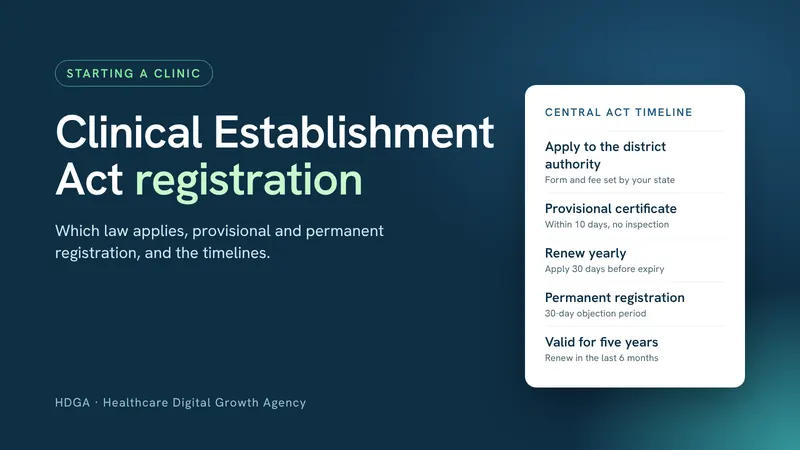
Provisional registration is based on your own declaration, with no inspection beforehand (section 16), so the information you give must be accurate. The authority must issue the certificate within ten days of receiving your application (section 15) and publish your details within 45 days (section 16).
Display the certificate where visitors can see it (section 18).
Step 7: Renew provisional registration on time
A provisional certificate is valid until the end of the twelfth month from issue (section 17). Apply for renewal at least 30 days before it expires; late applications cost more (section 22). Provisional registration cannot be extended indefinitely. Once standards for your category are notified, you have a limited window, generally two years, or six months for establishments set up after the standards were notified, to move to permanent registration (section 23).
Step 8: Apply for permanent registration
Once standards are notified for your category, apply for permanent registration with evidence that you meet them (sections 24 and 25). Then:
- Your evidence is displayed for 30 days so the public can object (section 26).
- Any objections are sent to you, and you have 45 days to respond (section 27).
- The authority decides within the following 30 days, and must record reasons if it refuses (section 29).
A permanent certificate is valid for five years. Apply to renew it within the six months before it expires (section 30).
Step 9: Keep meeting the conditions
Registration comes with conditions that continue for as long as you operate (section 12 and the central rules):
- Emergency care: provide the treatment needed to stabilise any emergency patient within your available staff and facilities.
- Records and reporting: maintain medical records and send the information and statistics the authority asks for.
- Display your rates: show the rates for your services and facilities prominently, in the local language and in English, under the Clinical Establishments (Central Government) Rules, 2012. On 12 October 2026 the Union Health Ministry wrote to states asking them to make sure hospitals display their rates and that patients can easily find treatment costs.
- Report changes: a change of ownership or management must be reported. A change of category or location, or closing down, means surrendering the certificate and applying afresh (section 20).
The rules also require charges to fall within a range set by the government, but that range has largely not been fixed, and the rule is being contested in the Supreme Court.
Penalties for running without registration
According to the Health Ministry's guidance on the central Act, running an unregistered establishment can attract a penalty of up to ₹10,000 for a first contravention, up to ₹50,000 for a second and up to ₹5 lakh for later ones. Knowingly working in an unregistered establishment can attract up to ₹25,000. The district administration can also close an unregistered establishment, and registration can be cancelled if its conditions are not met. State laws set their own penalties.
How registration connects to your marketing
- Use the registered name everywhere. Your Google Business Profile, website, signage and directory listings should match your registration exactly. Inconsistent names confuse patients and search engines. See Google Business Profile management.
- Advertising rules follow registration. For hospitals and clinics, the NMC advertising guidelines are read with the applicable Clinical Establishments Act, and where the two genuinely conflict, the Act prevails. Penalties for institutions are imposed under it. Our guide to what hospitals may advertise explains the rules.
- Publish your rates online as well. If you must display rates at the premises, putting the same factual information on your website helps patients and is the kind of content the advertising rules allow.
Common questions
Does a single-doctor clinic need registration?
Under the central Act, yes; single-doctor establishments are covered. Some state laws treat small clinics differently, so check your state's rules.
How long does registration take?
Provisional registration must be granted within ten days of a complete application. Permanent registration takes longer, with a 30-day objection period and up to 45 days to answer objections before the authority decides.
What does registration cost?
Fees are set by each state and vary by category. Your district registering authority or state portal will list them.
Is NABH accreditation enough?
No. NABH accreditation is voluntary and separate. Registration under the Clinical Establishments Act or your state law is compulsory.
Can we start operating while the application is pending?
Not without registration. Apply early enough that the provisional certificate is in hand before you see your first patient.
What to do next
Confirm which law applies in your state, read the minimum standards for your category, and apply for provisional registration well before opening day. If you are planning a new clinic or hospital, our clinic setup consulting team can take you from site selection to registration and launch, or book a call.
Sources
- Clinical Establishments (Registration and Regulation) Act, 2010: sections 11 to 30
- Clinical Establishments Act portal and FAQs, Ministry of Health and Family Welfare
- Ministry of Health and Family Welfare: status of the Clinical Establishments Act
- The South First: Centre asks states to ensure hospitals display service rates (13 October 2026)
- LiveLaw: Centre defends clinical establishment rate rule in the Supreme Court (11 August 2026)