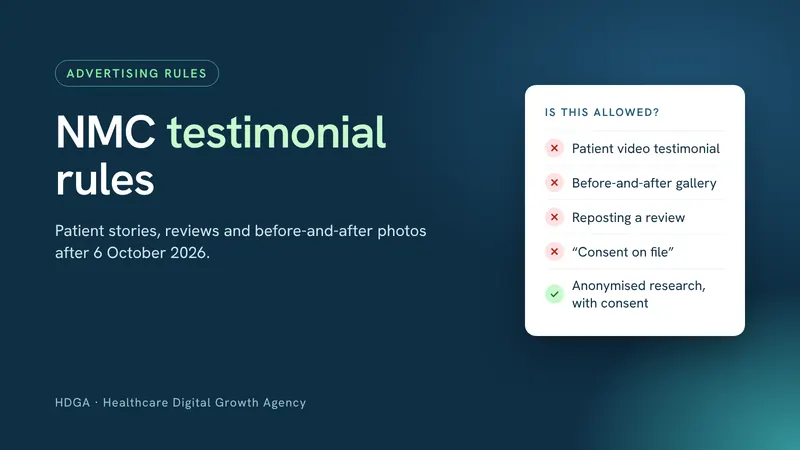
For years, the most persuasive thing on a clinic's Instagram was a happy patient: a thank-you video after IVF, a smile makeover gallery, a screenshot of a five-star review. Since 6 October 2026 most of that is off limits. The NMC testimonial rules in the new Guidelines on Ethical Advertising and Public Communication are direct, and they close the usual workaround: a signed consent form does not make a testimonial acceptable.
This guide sets out what the guidelines say, with their section numbers, which everyday posts now cross the line, and what to publish instead. For the full set of rules, read our NMC advertising guidelines 2026 explainer.
This article is based on the published text of the guidelines (NMC public notice dated 6 October 2026) and is not legal advice. Take advice on anything specific to your practice.
The short answer
- Patient testimonials used to promote a doctor are prohibited, whether written, video or a reposted review.
- Before-and-after photos and published surgical results are prohibited in advertising. The only exception is scientific or educational use, with the patient anonymised and consenting.
- Consent does not cure it. A testimonial that is otherwise prohibited stays prohibited even if the patient agreed in writing.
- Patients, celebrities, influencers and staff cannot be used to promote you, and neither can AI-made versions of any of them.
- Patients can still review you on their own. What you cannot do is solicit fake or paid reviews, or request and share reviews to promote yourself on social media.
What the guidelines actually say
The rules on testimonials and patient images sit in several places in the guidelines:
- Testimonials and endorsements: a registered doctor may not permit the use of their name, image, voice, testimonial or endorsement to promote services or products (section 8.1(ii)), and may not use or permit any celebrity, influencer, patient, employee or third party to promote their professional services (section 8.1(xi)).
- Reviews: doctors and institutions must not solicit, buy, procure, manipulate or publish fake, paid or misleading patient reviews, and doctors must not request or share patient testimonials or reviews for professional promotion on social media (section 3.2, Explanation V). Buying or manipulating followers, likes, reviews or ratings is banned separately (section 8.1(xii)).
- Consent: patient consent does not, by itself, make a testimonial or endorsement permissible (section 6.2).
- Before-and-after images: doctors must not display before-and-after photographs or advertise surgical results, except in scientific or educational material with the patient anonymised and consenting (section 8.1(v)).
- Patient material in general: patients' photographs, videos, medical records and clinical images may not be used for advertising unless the law permits it (section 6.1), and identifiable details such as names and faces must not be shared (section 7.4).
- AI: AI must not be used to create or alter a patient's image, testimonial, voice or clinical outcome (section 7.2(b)).
Hospitals and clinics are covered too. The patient-privacy rules apply to institutions, institutional advertising may not solicit patients or claim superiority (section 8.3(ii)), and any doctor named or shown in a hospital's testimonial is exposed personally.
Which everyday posts now cross the line
| Post | Under the 2026 guidelines |
|---|---|
| Video of a patient thanking the doctor after treatment | Not allowed, even with written consent |
| "Patient stories" page or testimonial slider on your website | Not allowed |
| Screenshot of a WhatsApp thank-you message on Instagram | Not allowed |
| Reposting or pinning a Google or Practo review | Not allowed for promotion |
| Review widget on the home page showing star ratings | High risk; treat as not allowed |
| Before-and-after gallery for hair, skin, dental or cosmetic work | Not allowed |
| Reel showing a patient's result to sell a procedure | Not allowed |
| Photo of a celebrity or influencer visiting the clinic, used to promote it | Not allowed |
| AI-generated "patient" describing their recovery | Not allowed |
| Anonymised clinical images in a journal or teaching talk, with consent | Allowed |
| A patient leaving a review on Google on their own | Allowed; it is not your post |
The test is purpose. The same clinical photo can be education in a lecture to doctors and prohibited advertising on your clinic's Instagram.
Why consent no longer settles it
Under the old approach, many practices kept a consent form on file and treated it as permission to publish anything. Section 6.2 ends that. Consent still matters, because you need specific, informed, documented consent before using any patient material where the law allows it (section 6.3). But consent is a minimum safeguard, not a licence. If the use itself is prohibited, as testimonials and before-and-after promotion are, the form does not help.
Reviews: what you can still do
Reviews have not disappeared; the way you handle them has changed.
- Let patients review you on their own. Google and Practo reviews written by patients are theirs, not your advertising.
- Do not buy, script, incentivise or filter reviews. Asking only happy patients, offering a discount for a review or writing reviews for patients all fall under section 3.2 or 8.1(xii).
- Do not repost reviews to promote yourself. Sharing a review on social media is exactly what Explanation V prohibits.
- Reply carefully. Thank the reviewer, never confirm that they were your patient, and never discuss their care. Our healthcare reputation management page covers replies within these limits.
Whether a neutral, non-incentivised request for feedback after a visit is acceptable has not been spelt out. Until it is, keep any request plain, send it to every patient alike, and never link it to anything the patient receives.
What to publish instead
Testimonials worked because they answered a patient's real question: will this work for someone like me, and what will it be like? You can still answer that question honestly, without a patient on screen.
- Explain the treatment step by step: what happens at each visit, how long recovery takes, and what most people experience, in ranges rather than promises.
- Show the place and the people: the clinic, the equipment, the team, and the doctor explaining things in their own words, with their registration details on every post.
- Answer the questions patients ask: cost ranges, what is included, risks, alternatives and who the treatment is not for. Our guide to answer engine optimization shows how to write these so search engines and AI tools pick them up.
- Publish real work properly: anonymised case series in a journal or a professional talk, which the guidelines allow.
- Use diagrams instead of patients: illustrations of a procedure or condition do not involve any patient's image.
Clean-up checklist
Work through every place a patient might see your name:
- Website: remove testimonial sliders, patient story pages, before-and-after galleries and review widgets.
- Instagram, Facebook and YouTube: archive patient videos, result reels, thank-you screenshots and reposted reviews.
- Google Business Profile: delete clinic-uploaded photos that show identifiable patients or results, and check posts for review quotes.
- WhatsApp status and broadcasts: stop sharing patient messages and results.
- Ads and landing pages: remove testimonials, result images and star-rating claims from creatives.
- Agencies and freelancers: tell them in writing what is now off limits, and ask for a list of everything published in your name. You stay responsible for it (section 4.4).
- Keep a record: note what you removed and when.
Our free healthcare marketing compliance checklist covers the rest of the guidelines in the same format.
What happens if you get it wrong
For doctors, the State Medical Council can act after a show-cause notice, with graded penalties from a warning and ethics training to suspension and, for repeated violations, removal from the register. Hospitals and clinics are dealt with under the Clinical Establishments Act or the applicable state law, and a doctor personally responsible for the content can face separate proceedings.
Common questions
Can I share a patient's video if they ask me to?
No. The patient's wish or consent does not make a promotional testimonial permissible under section 6.2.
Are before-and-after photos allowed with a disclaimer?
No. A disclaimer does not change the purpose. Before-and-after images are allowed only in scientific or educational material, with the patient anonymised and consenting.
Can I still show my Google rating on my website?
Showing ratings and reviews to promote yourself is risky under the rule against sharing reviews for promotion. A plain link to your Google Business Profile, without quotes or star badges, is the cautious option.
Do these rules apply to dentists and AYUSH practitioners?
These guidelines come from the National Medical Commission and apply to doctors registered with it, and to hospitals and clinics. Dentists and AYUSH practitioners are regulated by their own councils, and advertising codes such as ASCI's still apply to everyone. See our AYUSH advertising compliance and ASCI compliance pages.
What to do next
Spend an hour this week removing testimonials and before-and-after images from your website and social profiles. They are the most visible breach and the easiest to fix. If you want every channel checked, our NMC advertising compliance audit gives you a prioritised list of fixes, or book a call.
Sources
- NMC Guidelines on Ethical Advertising and Public Communication, public notice dated 6 October 2026 (PDF via Medical Dialogues)
- Medical Dialogues: doctors cannot use celebrities, influencers or patients to promote services (13 October 2026)
- Medical Dialogues: what the guidelines say about patient privacy and consent
- The South First: NMC says no to patient testimonials on Instagram
- National Medical Commission