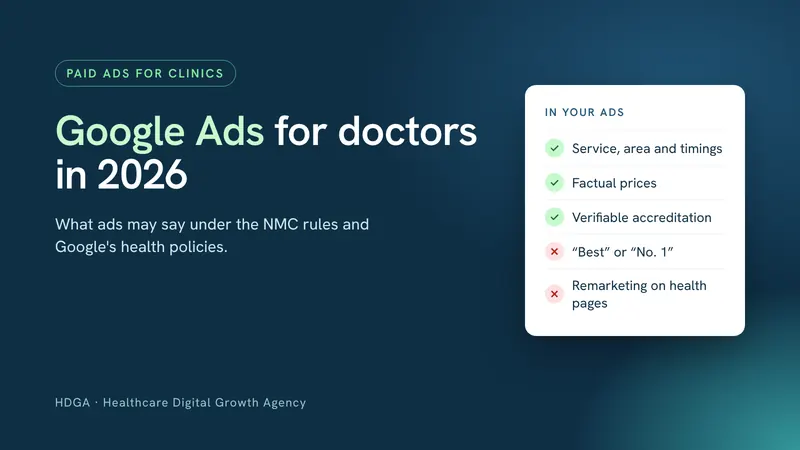
Search ads still work for clinics and hospitals. A patient who types "kidney stone specialist in Andheri" is ready to book, and a clear ad can put your practice in front of them at that moment. But since 6 October 2026, Google Ads for doctors in India has to satisfy two rulebooks at once: the National Medical Commission's advertising guidelines and Google's own healthcare and personalised advertising policies.
This guide explains what each one allows, how to write ads and landing pages that pass both, and where most clinic accounts go wrong.
This is a practical guide, not legal advice. NMC rules apply to registered doctors and, with clinical establishment law, to hospitals and clinics.
Two rulebooks
| NMC 2026 guidelines | Google Ads policies | |
|---|---|---|
| What it controls | What doctors and clinical establishments may say in any advertising | What Google will accept and how ads may be targeted |
| Main limits | No superiority claims, testimonials, guarantees, offers or inducements; payments per patient prohibited | Restricted healthcare content, certification for some advertisers, health treated as a sensitive category for targeting |
| Consequence | Professional misconduct proceedings | Ad disapproval or account suspension |
An ad Google approves can still break the NMC guidelines. Google does not check your claims against medical ethics; you have to.
What the NMC guidelines mean for search ads
The guidelines prohibit promotion through superiority claims, testimonials, outcome guarantees, discounts and offers, and paid rankings or partnerships that work as patient solicitation. Doctors and establishments may make factual announcements about their practice and share objective details of services. Read our NMC advertising guidelines 2026 explainer for the full list.
Paid search ads are not banned as such, but treat them as factual announcements:
Avoid in ads:
- "Best", "No. 1", "top", "leading" or "most trusted"
- "Painless", "100% success", "guaranteed results"
- discounts, free consultations as bait, "limited slots", festival offers
- patient reviews or star ratings in the ad text
- before-and-after claims
Safe in ads:
- the service and location: "Cardiology OPD in Andheri West"
- timings and how to book: "Mon to Sat, 9 am to 7 pm. Book online"
- facts you can prove: "NABH accredited", "MD Dermatology", "Cashless with major insurers"
- factual prices: "Consultation ₹800"
Example
Before: "Best Knee Replacement Surgeon in Pune. 100% Success. Free Consultation. Book Now!"
After: "Knee Replacement Surgery in Pune. Orthopaedic OPD Mon to Sat. Package Prices on Our Website. Book a Consultation."
Where the doctor's details go
The guidelines require doctors' electronic posts to show their name, qualifications and registration number. A search ad has no room for all of that, so put the full details on the landing page next to the doctor's name, and use the ad's assets for the essentials where you can (for example a sitelink to the doctor's profile).
What Google's policies mean for clinics
Healthcare content restrictions
Google restricts ads for prescription drugs, online pharmacies, unproven or experimental treatments and some other health products. From April 2026, online pharmacies in India can advertise after obtaining LegitScript certification and then Google's own certification. Ordinary consultation and procedure ads for clinics and hospitals do not need that certification, but ads that mention prescription medicines by name, or promote treatments Google considers unproven, will be limited or disapproved.
Targeting: health is a sensitive category
Google's personalised advertising policy treats health, including personal health conditions, treatments, invasive procedures and disabilities, as a sensitive interest category. For ads in this category:
- you cannot use your own remarketing lists, Customer Match uploads, lookalike segments or audience expansion
- users under 18 cannot be shown personalised ads at all
- Google's predefined audiences may still be available, and keyword and contextual targeting are unaffected
In practice, search campaigns built on keywords work as before. "Show ads to everyone who visited our IVF page" does not.
How to set up a compliant clinic account
- Verify the advertiser. Complete Google's advertiser verification in the practice's legal name, matching your registration.
- Build campaigns around services and areas, such as "dermatologist Bandra" or "cataract surgery cost Thane", not around conditions people may not want to be targeted for.
- Write factual ads using the safe list above.
- Send each ad to a matching page, not the home page. The page should show the doctor's details, timings, prices, address and a clear way to book.
- Use call and location assets, linked to your Google Business Profile.
- Track bookings, not clicks. Count calls, WhatsApp clicks and form submissions, and match them to appointments that happened.
- Keep health data out of ad platforms. Do not upload patient lists or send diagnosis details to Google. Under the DPDP Act and Google's policy, this is a double risk.
Landing pages decide whether ads pay
Most clinic ad budgets are lost after the click: a slow page, a form asking for too much, or a phone line nobody answers. Our hospital website design checklist covers what a good page needs. At minimum:
- loads quickly on a mid-range phone
- shows the doctor, qualifications, registration number and timings above the fold
- gives the price or price range
- offers call, WhatsApp and a short form with DPDP-ready consent wording (see our DPDP consent form templates)
- contains no testimonials, ratings widgets or superlatives
Common questions
Are Google Ads allowed for doctors under the NMC 2026 rules?
The guidelines do not ban search ads, but every ad must follow the same limits as other advertising: factual, no superiority claims, testimonials, guarantees or inducements.
Can I remarket to patients who visited my website?
For health-related ads, Google does not allow advertiser-curated audiences such as remarketing lists or Customer Match. Use search and contextual targeting instead.
Can I show my Google rating in my ads?
Avoid it. The NMC guidelines prohibit using reviews and ratings for promotion.
How much should a clinic spend on Google Ads?
Start with a budget that buys enough clicks for your two or three most important services in your area, measure the cost per booked patient for a month, then adjust. Our cost per qualified lead calculator helps you compare channels on what each enquiry really costs.
What to do next
Export your current ads and check every headline against the avoid list above, then check that each ad's landing page shows the doctor's details. If you would like a compliant account set up or audited, see our healthcare Google Ads agency service, or book a call.
Sources
- Google Ads Help: health in personalised advertising
- PPC Land: Google opens ads to India pharmacies via LegitScript (9 April 2026)
- Search Engine Land: running Google Ads in sensitive categories without remarketing
- The Policy Edge: NMC restricts misleading medical ads, paid rankings and AI-generated testimonials (10 October 2026)
- MedBound Times: NMC new rules for doctors on social media (8 October 2026)