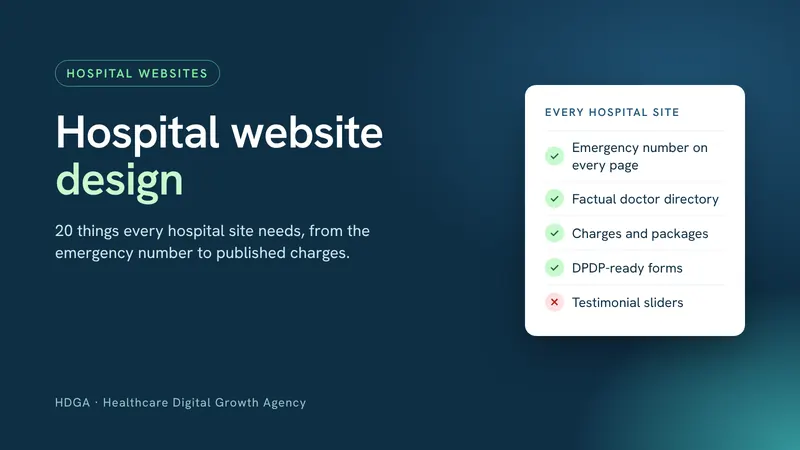
A hospital website has two audiences at once. One is a frightened family member on a mobile phone, looking for the emergency number or the way to the right entrance. The other is a patient weighing up where to have a procedure, comparing doctors, costs and insurance. Good hospital website design serves both, and in India it now also has to meet the NMC's 2026 advertising guidelines, the Clinical Establishments rules on displaying charges and the DPDP Act.
Here are 20 things every hospital site needs, grouped by what they do. If you are planning a rebuild, our healthcare website development team builds to this list.
Help patients in a hurry
1. The emergency number on every page
A 24-hour emergency and ambulance number, tappable on a phone, at the top of every page. Nobody in an emergency should have to look for it.
2. Directions that actually help
For each campus: a map, the full address, which entrance to use for emergency and for OPD, parking, and the nearest metro or bus stop. Large hospitals lose patients at the gate, not on Google.
3. OPD timings and how to book
Department-wise OPD days and timings, and at least two ways to book: online and a phone or WhatsApp number that is answered. Show what happens after booking, so patients know whether to expect a call.
Help patients choose
4. A page for each department
One page per department or specialty, describing the conditions treated, procedures offered, facilities, doctors and OPD timings. These pages rank for searches such as "cardiology hospital in Pune" and give AI answers something specific to cite.
5. A factual doctor directory
A profile for every doctor: full name, recognised qualifications, specialty, State Medical Council or NMR registration number, languages spoken and OPD days. The NMC's 2026 guidelines treat this kind of directory as patient information rather than advertising, provided it stays factual. No "best", "top" or "renowned".
6. Treatment and procedure pages
For your main procedures, explain what happens, length of stay, recovery, risks and alternatives, and link to the doctors who perform them.
7. Charges and packages
Publish package prices and charges factually: what is included, what is not, and what changes the price. Clinical establishments must already display their rates at the premises, in the local language and English, and the Union Health Ministry asked states on 12 October 2026 to make sure patients can easily find treatment costs. Putting the same information online is the obvious next step.
8. Insurance and empanelment
List the insurers and TPAs you accept for cashless treatment, and your empanelment status for government schemes, kept up to date. It is one of the most common questions patients phone in with.
9. Accreditation, stated accurately
NABH, NABL or other accreditation, with its scope and validity. If you mention a ranking or award, say who gave it, when and how, as the NMC guidelines require.
10. A patient guide
Admission, what to bring, visiting hours, food, payment, discharge, and how to get records and bills. Every question answered here is a phone call your front desk does not have to take.
11. An international patients page, if you serve them
Packages, visa letters, interpreters, and how to get in touch before travelling. The Health Ministry has encouraged hospitals to display package rates for international patients.
Earn trust within the rules
12. Medical content reviewed by named doctors
Every health information page should show who reviewed it, with qualifications, registration number and review date. It is what Google expects of health content, and what AI tools look for when choosing a source to cite.
13. No testimonials, before-and-after photos or superlatives
Since 6 October 2026, the NMC guidelines prohibit them, and patient consent does not make a testimonial acceptable. Remove testimonial sliders, patient-story pages and "best hospital" claims. See our guides to the NMC testimonial rules and what hospitals may advertise.
14. DPDP-ready forms
Every form should carry a clear notice of what data you collect and why, a required box for the enquiry itself, and separate, optional boxes for reminders and marketing. Ask for no medical details you do not need. Our DPDP consent form templates give wording you can adapt.
15. A privacy policy and grievance contact
A plain-language privacy policy, a named person or Data Protection Officer for data questions, and a simple way for patients to ask for access, correction or deletion. Under the DPDP Rules, requests must be answered within the period you publish, and no later than 90 days.
Get the technical basics right
16. Fast on an ordinary phone
Most visitors arrive on a mid-range Android phone over mobile data. Aim to pass Google's Core Web Vitals: the main content showing within 2.5 seconds, responses to taps within 200 milliseconds, and no content jumping around as the page loads. Heavy sliders, autoplay videos and chat widgets are the usual culprits.
17. Accessible to everyone
Patients and families include older people and people with disabilities. Meet the WCAG 2.2 AA standard: readable text sizes, strong colour contrast, keyboard navigation, alt text on images, captions on videos and clear form labels.
18. In your patients' languages
At minimum, the emergency information, directions, OPD timings and patient guide in the main languages of your catchment area. AI search in India now works in Hindi and several other Indian languages, and there is far less competition there.
19. Structured data and consistent details
Mark up the hospital, departments and doctors with the matching schema.org types (Hospital, MedicalClinic, Physician), and make sure the name, address, phone and hours match your Google Business Profiles exactly.
20. Measurement that counts bookings
Track calls, WhatsApp clicks, form submissions and online bookings by page and by source, and connect them to appointments that actually happened. A website that cannot show which pages bring patients will always lose its budget to something that can.
Common questions
How many pages does a hospital website need?
As many as you have departments, doctors and main procedures, plus the patient guide, locations, charges and policies. A 300-bed hospital typically needs well over a hundred pages, most of them department, doctor and procedure pages.
Should we show prices on our hospital website?
Yes, factually. Rates must already be displayed at the premises, the NMC guidelines allow factual disclosure of charges and packages, and cost is among the first things patients search for.
Can we keep our patient testimonial videos?
No. The NMC's 2026 guidelines prohibit testimonials used for promotion, even with the patient's consent.
How often should the site be updated?
Doctor profiles, OPD timings, charges and insurance lists should be checked monthly. Health content should be reviewed by a doctor at least once a year, with the review date shown.
What to do next
Score your current site against this list. Most hospital sites fail on numbers 7, 13, 14 and 16, and those are the quickest to fix. If you would like help, see our healthcare website development and conversion optimisation services, or book a call.
Sources
- NMC Guidelines on Ethical Advertising and Public Communication, 6 October 2026 (PDF via Medical Dialogues)
- The South First: Centre asks states to ensure hospitals display service rates (13 October 2026)
- Google Search Central: Core Web Vitals
- W3C: Web Content Accessibility Guidelines (WCAG) 2.2
- schema.org: Hospital