Every year, hundreds of thousands of people travel to India for treatment: heart surgery, joint replacement, transplants, cancer care, fertility treatment and more. For hospitals, international patients are a valuable and demanding group. They compare hospitals across countries, plan months ahead and need help with visas, travel and stays.
This guide covers medical tourism in India as it stands in 2026: the latest numbers, where patients come from, the rules hospitals must follow, and how to reach international patients without breaking the NMC's advertising guidelines.
The numbers
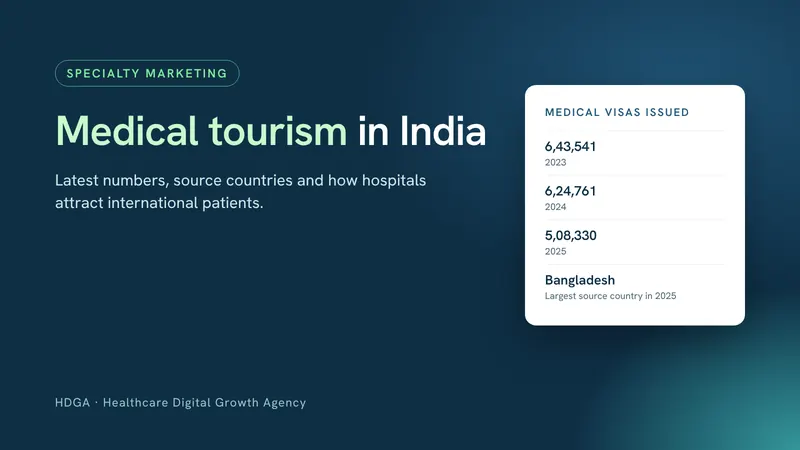
According to government figures reported in August 2026, India issued:
| Year | Medical visas (including e-visas) |
|---|---|
| 2023 | 6,43,541 |
| 2024 | 6,24,761 |
| 2025 | 5,08,330 |
That is more than 18 lakh medical visas in three years, to people from over 176 countries. In 2023 a further 15,650 medical attendant visas were issued, and in 2024 the government reported 1,054 AYUSH visas.
The fall in 2024 and 2025 is largely explained by Bangladesh, India's biggest source of medical travellers, where political unrest from mid-2024 disrupted travel. Even so, Bangladesh sent more than 3 lakh patients in 2025.
Where patients come from
The main source countries are Bangladesh, Iraq, Uzbekistan, Somalia, Turkmenistan, Oman and Kenya. Each market behaves differently:
- South Asia (Bangladesh, Nepal, the Maldives): close by, cost-sensitive, often travel overland or on short flights; families travel together.
- West Asia (Iraq, Oman, Yemen): often come for complex surgery, cancer care and transplants; Arabic-speaking coordinators matter.
- Central Asia (Uzbekistan, Turkmenistan): Russian-speaking; growing demand for cardiac, orthopaedic and oncology care.
- Africa (Somalia, Kenya, Nigeria, Tanzania): treatment not available at home is a key reason; referral networks and diaspora connections are important.
The main treatments sought are cardiac care, bone and joint surgery, organ transplants, neurological care, cancer treatment, cosmetic surgery, dental care, fertility treatment and AYUSH wellness. The leading destinations named are Chennai, Mumbai, New Delhi, Ahmedabad, Goa, Bengaluru and Kochi.
Rules hospitals must follow
Visas
Foreign patients should travel on a medical visa or e-medical visa, with companions on a medical attendant visa. A tourist visa suits a short consultation, not admission or surgery. The e-medical visa's validity was extended to one year. Patients usually need an invitation letter from the hospital with full treatment details, and extensions are handled through the e-FRRO portal. Rules change, so check the official Indian visa and FRRO websites before advising patients.
Reporting foreigners
The Immigration and Foreigners Act, 2025, in force since 1 September 2025, requires hospitals and nursing homes to report details of foreign nationals who stay at or visit them. Make sure your admissions desk knows the reporting process for your area.
Advertising
The NMC's 2026 guidelines apply to international marketing too. They allow factual information about services, doctors and charges, and prohibit testimonials, superiority claims, guarantees, offers and payments for procuring patients. Read our guide to what hospitals may advertise.
That last point matters most here. Many hospitals have relied on facilitators paid a commission per patient. Payments linked to referring or procuring patients are prohibited under the guidelines. Review facilitator contracts now, and move to fixed fees for genuine services such as travel, translation and accommodation, with legal advice.
How to attract international patients within the rules
1. Build an international patients section that answers everything
Patients abroad research for weeks. Give them, for each main procedure:
- what the procedure involves, length of hospital stay and how long to stay in India afterwards
- factual package prices: what is included, what is not and what changes the cost
- the doctors who perform it, with qualifications and registration numbers
- accreditation (NABH, JCI) with scope and validity
- the visa process, invitation letters and documents to bring
- accommodation, airport pickup, food and interpreters
2. Publish in your patients' languages
Arabic, Bengali, Russian, French and Swahili pages, written by native speakers and checked by doctors, reach patients that English-only competitors miss.
3. Rank for the searches patients make abroad
Patients search for "knee replacement cost in India", "best country for heart surgery" or "liver transplant in Chennai". Detailed, honest procedure and cost pages win these searches and get cited in AI answers. Our guides to medical SEO and AI Overviews explain how.
4. Make remote consultation easy
A fast way to send reports, a video consultation with the treating doctor, and a written treatment plan with a cost estimate before travel. This is the single biggest reason patients choose one hospital over another.
5. Work with referral partners properly
Doctors, insurers and embassies in source countries can refer appropriate patients. Build these relationships on education and service quality, not commissions per patient.
6. Look after the family
A patient travels with one or two family members who make the decisions. Help with accommodation, food, money exchange, SIM cards and religious needs. A good experience for the family is what brings the next patient from the same town.
7. Follow up after they go home
Agree follow-up with a local doctor, share discharge summaries promptly, and keep teleconsultation open for questions.
Common questions
How many medical tourists come to India?
India issued 5,08,330 medical visas in 2025, 6,24,761 in 2024 and 6,43,541 in 2023, according to government figures reported in August 2026.
Which country sends the most medical tourists to India?
Bangladesh, with more than 3 lakh patients in 2025, followed by Iraq.
Can hospitals pay medical tourism facilitators?
Payments linked to referring or procuring patients are prohibited under the NMC's 2026 guidelines. Fixed fees for genuine services are a different matter, but take legal advice on your contracts.
Can hospitals publish package prices for international patients?
Yes. Factual charges and packages are allowed and are what international patients look for first.
What to do next
Look at your international patients page as a family in Baghdad or Tashkent would: can they find the price, the doctor, the visa steps and a way to send reports in under two minutes? If not, start there. If you would like help, see our medical tourism marketing service, or book a call.
Sources
- ETV Bharat: over 18 lakh foreigners visited India for medical treatment from 176 countries (4 August 2026)
- Factly: medical visas issued by India fell more than 20% in 2024
- Drishti IAS: Immigration and Foreigners Act, 2025 (5 September 2025)
- TaxGuru: visa rules and FRRO obligations for foreigners seeking treatment in India (June 2026)
- Medical Dialogues: NMC lists permitted and prohibited advertising practices for hospitals