Every doctor who has been in practice for a while has read a review that felt unfair: a complaint about a wait that was caused by an emergency, a diagnosis described wrongly, or something that never happened. The instinct is to reply and set the record straight. That instinct is where most of the damage happens.
This guide explains how to respond to negative reviews as a doctor or clinic in India: the confidentiality rules that apply, what a good reply looks like, ten templates you can adapt, when not to reply, and what to do about fake or defamatory reviews.
This is practical guidance, not legal advice. For a review that threatens legal action or alleges negligence, speak to your medical indemnity provider or a lawyer before replying.
The one rule: confidentiality comes first
Doctors in India owe patients confidentiality under the Indian Medical Council (Professional Conduct, Etiquette and Ethics) Regulations, 2002, and health information is protected personal data under the Digital Personal Data Protection Act. A public reply that confirms someone was your patient, or mentions anything about their visit, can breach both, even if the patient talked about it first.
Medical defence organisations abroad give the same advice for the same reason: a patient choosing to share their story does not release the doctor from confidentiality. Cases of doctors facing complaints for replying to reviews are not unusual.
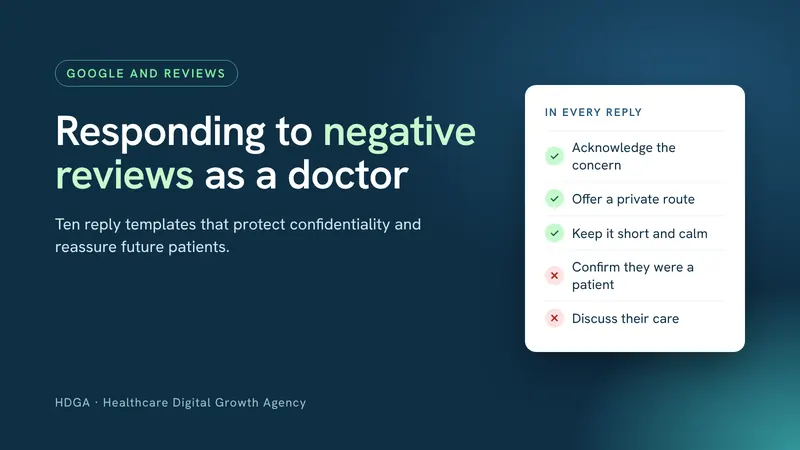
So, in every reply:
- Do not confirm that the reviewer is or was a patient.
- Do not mention symptoms, diagnosis, treatment, dates, bills or anything said in consultation.
- Do not argue or correct their version of events in public.
- Do acknowledge the concern, state your general standard, and offer a private route to resolve it.
What a good reply does
- Thanks or acknowledges the reviewer without admitting or denying anything specific.
- Shows you take concerns seriously, in general terms.
- Moves the conversation offline to a named role and a phone number.
- Is short, calm and signed by the practice, not an individual's personal account.
- Is written for future patients, who will judge you by the tone of the reply more than by the review.
Ten templates
Replace the brackets, keep them short, and vary the wording so replies do not look automated.
1. General complaint
We are sorry to read this. We take every concern seriously and would like to understand what happened. Please call our patient relations team on [number] so we can look into it. — The team at [Clinic name]
2. Waiting time
Thank you for your feedback. We know waiting is frustrating, and delays sometimes happen when urgent cases need attention. We are working to keep waits shorter and would welcome the chance to hear more. Please call us on [number]. — [Clinic name]
3. Staff behaviour
We are sorry to hear this. We expect every member of our team to treat people with courtesy and respect, and we would like to look into this. Please contact our practice manager on [number]. — [Clinic name]
4. Billing or cost
Thank you for raising this. We aim to explain charges clearly before any service, and our rates are displayed at the clinic. If you have a question about a bill, please contact our billing desk on [number] and we will go through it with you. — [Clinic name]
5. Unhappy with the outcome
We are sorry to read that you are unhappy. We cannot discuss anyone's care in public, but we would like to talk this through properly. Please call [number] and ask for the [patient relations / medical director's] office. — [Clinic name]
6. Appointment or phone problems
Thank you for letting us know. We are sorry it was hard to reach us. We are reviewing how we handle calls and bookings, and would appreciate hearing more on [number]. — [Clinic name]
7. Review that seems to be about another clinic
Thank you for your review. We cannot find anything matching this description, and it may relate to a different practice. If you did visit us, please call [number] so we can look into it. — [Clinic name]
8. Rating with no text
Thank you for your rating. If there is anything we could have done better, we would welcome your feedback on [number]. — [Clinic name]
9. Abusive review Do not reply in kind. Report it to Google (see below). If you reply at all:
We welcome all feedback and want to resolve any concern. Please contact us on [number]. — [Clinic name]
10. Mixed review
Thank you for taking the time to share your feedback, including what we could do better. We would like to hear more and have passed your comments to our team. Please call [number] if you would like to talk. — [Clinic name]
For positive reviews, a short thank-you that does not confirm the reviewer was a patient is enough. Do not repost reviews on social media; the NMC's 2026 guidelines restrict sharing reviews for promotion.
When not to reply publicly
- The review threatens legal action or alleges negligence: speak to your indemnity provider first.
- The reviewer is in the middle of active treatment: contact them through normal clinical channels instead.
- You are angry: wait 24 hours and have someone else read your draft.
- It is clearly spam or abuse: report it instead.
Handle it offline properly
A reply only works if something happens when the reviewer calls. Have one named person handle review follow-ups, call back within a working day, listen first, and record what was agreed. Many reviewers update or remove a review after a good conversation, but never ask them to as a condition of resolving their concern.
Fake, abusive and defamatory reviews
- Report to Google: from your Business Profile, flag reviews that break Google's policies, such as fake engagement, off-topic content, harassment, hate speech or conflicts of interest. Keep a record of what you reported and when.
- Request a review: if Google declines, you can ask for the decision to be looked at again from the same reporting tool.
- Legal routes: for genuinely defamatory content, Google has a separate legal removal request process. Take legal advice first; a lawsuit can draw far more attention to a review than the review ever had.
- Do not create fake positive reviews to bury bad ones, or ask staff and family to post reviews. It breaks Google's rules and the NMC guidelines.
Prevent the next one
Most negative reviews follow a problem that could have been fixed in the clinic: a long wait with no explanation, an unclear bill, a phone that nobody answered. Track the themes in your reviews each month and fix the most common one first. See our guide to Google reviews under NMC 2026.
Common questions
Should doctors reply to negative reviews at all?
Usually yes, briefly and without any clinical detail. A calm reply reassures future patients. In some cases, such as threatened legal action, it is better not to reply until you have advice.
Can I explain what really happened?
Not in public. Even if the review is inaccurate, explaining would confirm the person was a patient and disclose details of their care.
Can I ask Google to remove a negative review?
Only if it breaks Google's policies, for example if it is fake, abusive or off-topic. A genuine negative experience is not removed because it is negative.
Can I sue for a fake review?
Defamation action is possible in principle, but it is slow, costly and public. Report the review to Google first and take legal advice before going further.
What to do next
Save these templates for your team, agree who handles review follow-up calls, and reply to any unanswered negative reviews this week. If you would like replies drafted and monitored for you, see our negative review response service and healthcare reputation management, or book a call.
Sources
- Medical Independent: responding to online criticism, best practices for doctors (7 April 2025)
- Medical Protection: dealing with negative online reviews
- MDU: dealing with online criticism
- Google Maps user contributed content policy
- NMC Guidelines on Ethical Advertising and Public Communication, 6 October 2026 (PDF via Medical Dialogues)