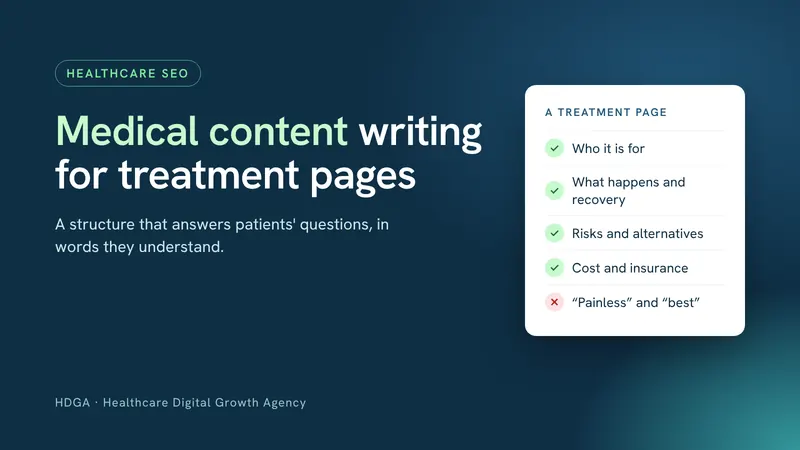
A treatment page has one job: help a worried person decide whether this treatment, at this clinic, is right for them. Most clinic websites in India fail at it. The page says the clinic has "state-of-the-art technology" and "experienced doctors", lists a few benefits, and ends with "Book now". It answers none of the questions the patient actually has.
This guide covers medical content writing for treatment and procedure pages: a structure that answers patients' questions, how to write it so people understand, how to handle cost and risk honestly, and how to keep it within the NMC's 2026 advertising guidelines.
What patients want to know
Before writing, list the questions patients ask at the desk and in the consultation. For almost any procedure they include:
- Is this the right treatment for my problem?
- What happens before, during and after?
- Will it hurt, and how long until I am back to normal?
- What are the risks, and how often do they happen?
- What are the alternatives?
- How much will it cost, and will insurance cover it?
- Who will do it, and what are their qualifications?
A good treatment page answers all seven, in that order of importance.
A structure that works
1. A plain summary at the top
Two to four sentences: what the treatment is, who it is for, and what it achieves. This is what search snippets and AI answers quote.
Cataract surgery replaces the cloudy lens in your eye with a clear artificial one. It is usually done as a day procedure under local anaesthetic, takes about 20 to 30 minutes, and most people notice clearer vision within a few days.
2. Who it is for, and who it is not for
Describe the symptoms and situations where the treatment is usually recommended, and when it is not suitable. This builds trust because it shows you are not trying to sell the procedure to everyone.
3. Before, during and after
Step by step: tests and preparation, what happens on the day, length of stay, and recovery week by week. Practical details matter: fasting, what to bring, when you can drive, return to work.
4. Risks and side effects
State the common side effects and the serious but rare risks, honestly and in proportion. Patients find this anyway; hearing it from you builds trust.
5. Alternatives
Other treatments, including watchful waiting where appropriate. The NMC guidelines expect communication to be balanced and not misleading.
6. Cost and insurance
A factual price range, what is included and excluded, and what changes the price. Say which insurers and schemes you accept. The guidelines allow factual disclosure of charges. Our setup cost calculators show how far specific numbers go in helping people decide.
7. The doctors
Who performs it, with qualifications and registration numbers, linked to their profiles.
8. Questions and next step
Short answers to the remaining common questions, then a clear, calm next step: book a consultation, call, or send reports on WhatsApp.
9. Review line and sources
"Medically reviewed by Dr [Name], [qualifications], Reg. No. [number]. Last reviewed [date]", followed by the sources you used. See our guide to E-E-A-T for medical websites.
Writing so patients understand
- Short sentences. One idea each. Aim for most sentences under 20 words.
- Everyday words first. "Kidney stone" before "renal calculus"; explain the medical term once if patients will hear it.
- Talk to the reader. "You will be able to walk the next day", not "Patients are mobilised on post-operative day one."
- Numbers patients can use. "About 2 in 100 people", not "a low incidence".
- Headings that are questions. "How long does recovery take?" is what people search for.
- Translate properly. Hindi and regional-language versions should be written by native speakers and reviewed by a doctor, not machine-translated.
What to leave out
- "Best", "advanced", "world-class", "painless", "guaranteed" and "100% success"
- testimonials, patient stories and before-and-after photos, which the NMC's 2026 guidelines prohibit
- success rates you cannot source
- urgency: "limited slots", "book today"
- stock photos of smiling models presented as patients
See our guides to the NMC advertising guidelines 2026 and NMC testimonial rules.
The review process
- A writer drafts from an interview with the treating doctor and from current guidelines.
- The doctor reviews every clinical statement and corrects it.
- An editor checks clarity, reading level and the NMC rules.
- The page is published with the reviewer's name, the date and sources.
- It is reviewed at least once a year, or when practice changes.
If AI tools help with drafting, the same process applies. See our guide to ChatGPT for doctors.
Before and after
Before:
Our state-of-the-art laser centre offers painless LASIK with world-class results. Book your free consultation today!
After:
LASIK reshapes the front of your eye with a laser to correct short sight, long sight or astigmatism. It suits most adults over 18 whose prescription has been stable for at least a year. Each eye takes a few minutes, and most people see well enough to return to desk work within a few days. Not everyone is suitable: thin corneas, some eye conditions and pregnancy can rule it out, which is why we do detailed tests first.
Common questions
How long should a treatment page be?
Long enough to answer the seven questions above, usually 1,000 to 2,000 words. Use headings so readers can jump to what they need.
Who should write medical content?
A writer who can interview doctors and write plainly, with every page reviewed and signed off by a qualified doctor.
Should we publish prices?
Yes, as a factual range with what is included. Cost is one of the first things patients look for.
Can we use patient stories on treatment pages?
No. The NMC's 2026 guidelines prohibit testimonials, even with consent.
What to do next
Pick your most important treatment page and check it against the nine-part structure. Rewrite the summary first; it is the part patients, Google and AI assistants all read. If you would like your treatment pages written and doctor-reviewed, see our healthcare content marketing and medical SEO services, or book a call.