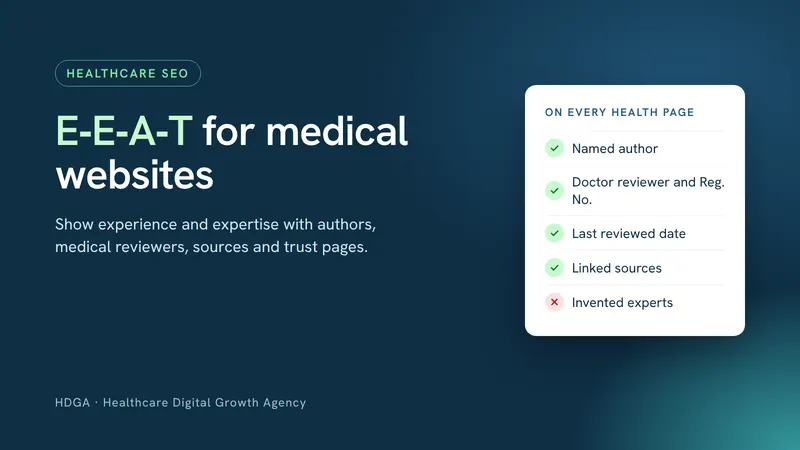
Health is the area where Google is most careful about which pages it shows. Its Search Quality Rater Guidelines treat health topics as "Your Money or Your Life" (YMYL): subjects where poor information could harm someone. For these pages, the guidelines ask raters to look hard at E-E-A-T: experience, expertise, authoritativeness and, above all, trust.
This guide explains E-E-A-T for medical websites in practical terms: what Google is looking for, and how a clinic or hospital in India can show it through author bios, medical reviewers, citations and trust pages, without breaking the NMC's 2026 advertising guidelines.
What E-E-A-T means
| Letter | Question | On a clinic website |
|---|---|---|
| Experience | Has the creator actually done or lived this? | Doctors who perform the procedure explain it |
| Expertise | Do they have the knowledge and skill? | Recognised qualifications and specialty |
| Authoritativeness | Are they a known source on the topic? | Hospital affiliations, publications, teaching, citations by others |
| Trust | Is the page accurate, honest and safe? | Correct facts, sources, review dates, clear ownership and contact details |
Google describes trust as the most important of the four. Raters do not set rankings themselves; their ratings help Google evaluate whether its systems are surfacing reliable results. The September 2025 update to the guidelines was described by Google as minor, adding clarifications and examples, including for AI Overviews, without changing the rating guidance.
E-E-A-T is not a score or a tag. It is the overall impression a page and site give, which is why it has to be built into how content is written and published.
1. Name a real author on every health page
- Each article shows who wrote it, with a link to a short author page.
- If a medical writer drafts content, say so, and name the doctor who reviewed it.
- Never invent authors, use stock photos as headshots or give credentials someone does not hold. Raters are told to treat deception about who created content as a sign of the lowest quality.
2. Add a named medical reviewer
A medical reviewer line is the single most useful E-E-A-T signal for a clinic site:
Medically reviewed by Dr [Name], MS (Orthopaedics), Reg. No. [number], [State] Medical Council. Last reviewed: [date].
- The reviewer should be a specialist in the topic.
- Link the name to their profile page.
- Show the review date, and re-review at least once a year or when guidelines change.
The NMC's 2026 guidelines require doctors' electronic communication to show their name, qualifications and registration number, so this line also helps you meet the disclosure rules.
3. Build proper doctor profile pages
Each doctor's page should include:
- full name, photo, qualifications and the institutions that awarded them
- registration number and council
- specialty, areas of clinical work and procedures performed
- years in practice, hospital affiliations and languages spoken
- publications, teaching roles and professional memberships
- OPD days and how to book
Keep it factual. "Renowned", "best" and "top" are restricted under the NMC guidelines, and they add nothing to trust. Mark each profile up with schema.org Physician structured data.
4. Cite your sources
- Link medical claims to guidelines, peer-reviewed studies and official sources such as ICMR, the Union Health Ministry or WHO.
- Prefer Indian guidance where it exists; treatment norms and drug availability differ between countries.
- Cite the specific page, not a home page.
- Avoid claims you cannot support, especially numbers: success rates and outcome figures need a real source.
5. Show experience the right way
Experience is where clinics have an advantage over general health sites, but the NMC rules close off the old approach of patient stories and before-and-after photos. Show experience through:
- the doctor explaining what they see in practice ("most patients we see with this need...")
- process detail only someone who does the procedure would know: preparation, what happens on the day, recovery milestones
- original photos and videos of your own facilities and team, without identifiable patients
- local detail: costs at your centre, insurance accepted, how to reach you
6. Make the organisation trustworthy
- About page with the legal entity, registration and leadership.
- Full address, phone and map; contact routes that work.
- Privacy policy, terms and a grievance contact.
- Accreditation stated accurately, with scope and validity.
- A corrections policy: how readers can report an error, and how quickly you fix it.
Our medical SEO checklist covers the rest of the technical and trust basics.
7. Use AI carefully
Google's guidance does not ban AI-assisted content, but its rater guidelines treat large volumes of generated text published without human oversight as low effort and low quality, and health content gets the strictest reading. Use AI for drafts only, check every fact, and have a doctor review and sign off. See our guides to ChatGPT for doctors and the NMC AI-generated content rule.
Why this matters for AI answers too
AI Overviews, AI Mode, ChatGPT and other assistants choose which pages to cite. Pages with named experts, clear sources, review dates and consistent details across the web are easier for them to trust and quote. See our guide to generative engine optimization.
A quick audit
- [ ] Every health page has a named author and a named medical reviewer with registration number.
- [ ] Every page shows a last-reviewed date within the past year.
- [ ] Every doctor has a factual profile page with structured data.
- [ ] Medical claims link to specific, reliable sources.
- [ ] No testimonials, superlatives or unverifiable outcome figures.
- [ ] About, contact, privacy and grievance pages are complete.
- [ ] AI-assisted content has been checked and signed off by a doctor.
Common questions
Is E-E-A-T a ranking factor?
Not as a single score. Google uses many signals to identify helpful, reliable content, and E-E-A-T describes what those signals aim to reward. For health topics, it matters more than almost anywhere else.
Does every page need a doctor as the author?
No, but every page with health information should be reviewed by a qualified doctor, and the page should say who.
Can a medical writer write our content?
Yes. Name the writer, name the medical reviewer, and make sure the review is genuine.
How often should medical content be reviewed?
At least once a year, and whenever guidelines, drug approvals or your services change. Show the latest review date on the page.
What to do next
Take your ten most visited health pages and add a named reviewer, a review date and linked sources to each this month. If you would like help building E-E-A-T into your content process, see our healthcare SEO services and healthcare content marketing pages, or book a call.
Sources
- Google Search Central: creating helpful, reliable, people-first content
- Google: Search Quality Rater Guidelines (PDF)
- Search Engine Land: Google updates search quality rater guidelines with AI Overview examples and YMYL definitions (September 2025)
- Google Search Central: guidance on using generative AI content
- schema.org: Physician