For most Indian clinics, WhatsApp is the busiest channel they have. Patients book on it, ask about timings, receive reports and get reminders. It is also where clinics are most likely to break privacy rules without noticing: broadcast lists built from the appointment register, offers sent to every patient, reports sent to the wrong number.
This guide explains WhatsApp marketing for clinics under three sets of rules that apply at once: the Digital Personal Data Protection Act and Rules, WhatsApp's own Business Messaging Policy, and the NMC's 2026 advertising guidelines. It covers what you can send, the consent you need, and what it costs in 2026.
This is a practical guide, not legal advice. Check your own setup with a privacy adviser.
Three rulebooks
| Rulebook | What it controls |
|---|---|
| DPDP Act, 2023 and DPDP Rules, 2025 | Whether you may use a patient's phone number and health information, and how you collect consent |
| WhatsApp Business Messaging Policy | Who you may message, what you may message about, and how opt-outs work |
| NMC advertising guidelines, 2026 | What the content of a promotional message may say |
DPDP: consent comes first
The DPDP Rules were notified on 13 November 2025. Most obligations for clinics, including notice, consent, security safeguards, breach reporting and patients' rights, apply 18 months after notification, from May 2027. Clinics that start now will be ready, and patients already expect it.
What it means for WhatsApp:
- A number given for an appointment is not consent for marketing. Reminders about that appointment are part of the service the patient asked for. Health tips, newsletters or service announcements are a separate purpose and need separate consent.
- Consent must be specific, informed and easy to withdraw. Use a clear notice and a separate, unticked box for WhatsApp updates.
- Health details need extra care. A message saying "Your HIV test report is ready" on a shared family phone is a breach waiting to happen. Keep clinical details out of messages and send a secure link instead.
- Keep records of when and how each patient consented, and process withdrawals promptly.
Our DPDP consent form templates include wording for WhatsApp, and our guide to the DPDP Rules for hospitals and clinics covers the timeline.
Sample consent wording
☐ I agree to receive appointment reminders and report alerts from [Clinic name] on WhatsApp. (Needed for these reminders.)
☐ I would also like to receive health information and clinic updates from [Clinic name] on WhatsApp. I can stop these at any time by replying STOP.
WhatsApp's own rules
WhatsApp's Business Messaging Policy applies whether you use the WhatsApp Business app or the WhatsApp Business Platform (API):
- Opt-in is required. You may only message people who have given you their number and agreed to receive messages from you.
- Opt-outs must be honoured, whether the person asks on WhatsApp or anywhere else, and businesses should explain how to opt out of specific kinds of messages.
- Drugs and medical products are restricted. The policy prohibits using WhatsApp to transact in or promote prescription drugs and medical and healthcare products, whatever licences you hold. Clinic services are not the same as selling medical products, but keep pharmacy promotions off WhatsApp.
- Sensitive health information: the policy says businesses should not use WhatsApp for telemedicine or to send or request health information where regulations require stricter safeguards than WhatsApp provides.
- A privacy policy must be published and the necessary notices and consents obtained.
Clinics that send many messages, or use automation, should use the WhatsApp Business Platform through an approved provider, with message templates approved by Meta.
The NMC guidelines: what messages may say
Promotional messages from doctors and clinical establishments must follow the same rules as any other advertising since 6 October 2026: no testimonials, superiority claims, guarantees, discounts or "limited slots". Messages that include the doctor should show their name, qualifications and registration number. See our NMC advertising guidelines 2026 explainer.
What you can send
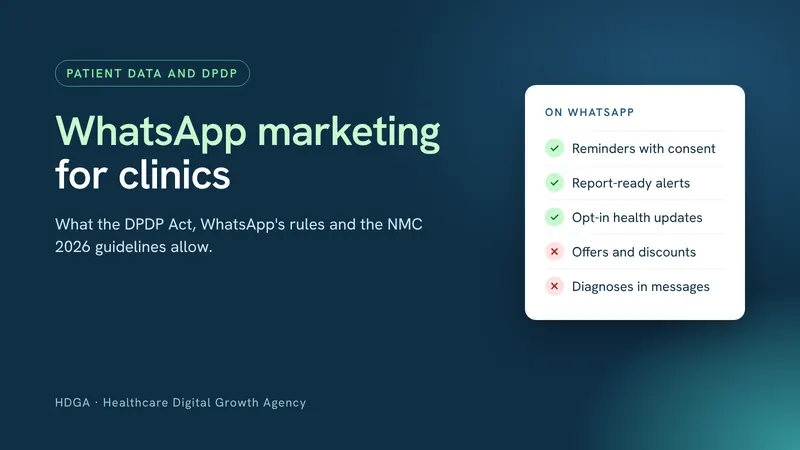
| Message | Consent needed | Notes |
|---|---|---|
| Appointment confirmation and reminder | Part of the booking | Time, doctor, address; no diagnosis |
| Report ready | Part of the service | "Your report is ready" with a secure link, not the result |
| Follow-up reminder | Part of the care, if agreed at the visit | Keep it general |
| Vaccination schedule reminders | Part of the care, if agreed | For the parent who registered the child |
| Health information | Separate opt-in | Educational, no offers |
| New service, new doctor, holiday timings | Separate opt-in | Factual announcement |
| Festival offers, discounts | Not allowed | Prohibited by the NMC guidelines |
| Requests for Google reviews | Avoid | See our guide to Google reviews under NMC 2026 |
Common mistakes
- adding every patient in the register to a broadcast list
- using a doctor's personal WhatsApp for clinic messages, with patient chats on a personal phone
- forwarding reports or images between staff on personal numbers
- writing diagnoses or test names in message previews
- no way to stop messages except blocking the clinic
- staff WhatsApp groups that include patient details
What it costs in 2026
WhatsApp moved to charging per delivered message on 1 July 2025. Messages patients send to you are free. Reported Indian rates in 2026 are about ₹0.86 per marketing message and ₹0.115 per utility message (such as reminders and report alerts). Since 1 October 2026, utility messages sent within the 24-hour customer service window are also charged, with 1,000 free service messages per business number each month. Rates are set by Meta and change, so check your provider's current rate card.
Utility messages are far cheaper than marketing messages, but Meta decides the category when it approves a template. A reminder with a promotional line added will be charged as marketing.
A simple setup for clinics
- One business number, on the WhatsApp Business app for small practices or the Platform for larger ones, never doctors' personal numbers.
- Consent in the registration form, with separate boxes for service messages and updates.
- Templates for each message type, reviewed for privacy and the NMC rules.
- No clinical details in messages; secure links for reports.
- A clear opt-out in every update message, processed the same day.
- Access controls: who can see chats, and what happens when staff leave.
- Monthly check: consent records, opt-outs and a sample of messages sent.
Common questions
Can clinics send WhatsApp messages to patients?
Yes, for services the patient asked for, such as appointment reminders and report alerts, and for health information and updates if the patient has separately opted in.
Do I need consent for appointment reminders?
They are part of the service the patient requested, but tell patients clearly at booking that reminders will come on WhatsApp, and let them choose another channel.
Can I send offers on WhatsApp?
No. Discounts and offers by doctors and clinical establishments are prohibited under the NMC's 2026 guidelines.
Can I send lab reports on WhatsApp?
Sending a secure, access-controlled link is safer than sending the report itself. Whatever you send, make sure it goes only to the number the patient gave for that purpose.
What to do next
Check your clinic's registration form and WhatsApp broadcast lists this week: separate consent for updates, remove anyone who did not opt in, and take clinical details out of message templates. If you would like help, see our DPDP implementation and healthcare compliance advisory services, or book a call.
Sources
- WhatsApp Business Messaging Policy
- Meta for Developers: pricing on the WhatsApp Business Platform
- MyOperator: WhatsApp Business API pricing in India, 2026
- AZB & Partners: DPDP Act phased rollout and key compliance milestones (14 November 2025)
- MedBound Times: NMC new rules for doctors on social media (8 October 2026)