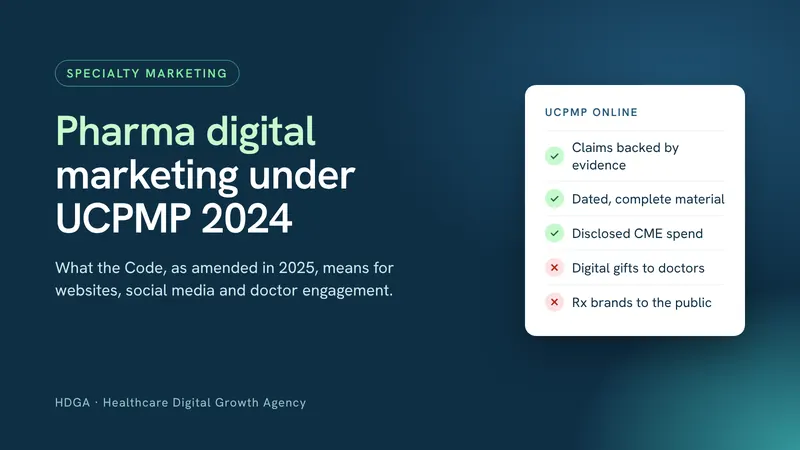
Pharmaceutical marketing in India has moved online: detailing apps, doctor webinars, WhatsApp groups for medical representatives, disease awareness websites and social media. The rules have not been rewritten for each channel. Instead, the Uniform Code for Pharmaceutical Marketing Practices (UCPMP) 2024 applies to promotion in any form, alongside India's drug laws and, for anything aimed at the public, the ASCI Code and the Drugs and Magic Remedies Act.
This guide explains what that means for pharma digital marketing: what the Code requires, how it applies to digital channels, the 2025 amendments, and a practical checklist.
This is an overview, not legal advice. Read the current Code on the Department of Pharmaceuticals website and take advice on specific campaigns.
UCPMP 2024 in brief
The Department of Pharmaceuticals notified UCPMP 2024 on 12 March 2024, replacing the 2014 code. It was amended in August and October 2024 and again on 1 September 2025.
Key points:
- No promotion before approval. A drug must not be promoted before it receives marketing approval, and only for the approved uses.
- Claims must be substantiated. Information must be balanced, up to date, verifiable and backed by evidence on request. Comparisons must be fair.
- "Safe" and "new". "Safe" cannot be used without qualification, and "new" cannot describe a drug that has been generally available in India for more than a year.
- Promotional material must show the company's details, generic names, dosage, adverse reactions and a date, and must not disguise its promotional nature.
- No gifts, travel, hospitality or cash to healthcare professionals or their families, except travel and hospitality for genuine CME or CPD speakers.
- Brand reminders are limited to educational items worth up to ₹1,000 each, and free samples are capped at 12 packs per drug per prescriber per year.
- CME and CPD events may not be held abroad, must be disclosed on the company website with expenditure, and domestic events must keep a speaker-to-participant ratio within 1:10.
- Ethics committees handle complaints, and the company's chief executive is responsible for compliance and an annual self-declaration.
What changed in September 2025
The 2025 amendment made the chief executive explicitly responsible for adherence to the Code, required marketing expenditure, including the value of free samples and education programmes, to be disclosed in a prescribed format within two months of each financial year's end, and set out how sample values are calculated.
Is it binding?
UCPMP is a code implemented through pharmaceutical associations, without statutory penalties of its own. Penalties include reprimand, corrective statements, suspension or expulsion from the association, and recovery of benefits given in breach. Critics, including the medical representatives' federation FMRAI, have long argued it should be made statutory, and the matter has been before the Supreme Court. Even so, breaches can also fall foul of drug laws, consumer protection law and the NMC's rules for doctors, so treat the Code as the minimum.
How the Code applies to digital channels
The Code has no separate section on social media or digital promotion. Its general rules apply to whatever channel you use.
Websites and disease awareness pages
- Prescription drug promotion is for healthcare professionals. Gate product information for HCPs behind a verification step, and keep public pages to disease awareness without brand promotion.
- Disease awareness must not be disguised promotion. The Code prohibits material that hides its promotional nature or resembles independent editorial content.
- Date everything. Promotional material must carry a date; keep a record of versions.
- Check the DMR Act before naming any condition in public-facing content. See our guide to the Drugs and Magic Remedies Act.
Social media
- No brand promotion of prescription drugs to the public.
- Do not use healthcare professionals' names or photographs in promotional material; the Code prohibits it.
- Paid influencers promoting prescription medicines are out of bounds. For consumer health and OTC products, follow ASCI's influencer rules, including upfront disclosure and qualifications for health advice. See our guide to the ASCI guidelines for healthcare.
- Monitor comments for reports of side effects and route them to pharmacovigilance.
Doctor engagement: e-detailing, apps and WhatsApp
- Content in e-detailing apps and representative WhatsApp messages is promotional material and must meet the same requirements as print.
- No gifts in digital form: subscriptions, vouchers, devices or paid app access for doctors are gifts under the Code.
- Consent: doctors are data principals under the DPDP Act. Collect clear consent for messages and honour withdrawal. See our DPDP consent form templates.
Webinars and virtual CME
- Run them to the same standard as in-person CME: clear educational purpose, transparent selection of speakers, and disclosure of the event and expenditure on the company website.
- Speaker fees must be for genuine services under a written agreement.
- Keep the domestic speaker-to-participant ratio within 1:10.
Doctors as content creators
The NMC's 2026 advertising guidelines prohibit doctors from endorsing products and from paid promotion that works as solicitation. A company paying a doctor to promote its brand online risks breaching both the UCPMP and the NMC guidelines. See our NMC advertising guidelines 2026 explainer.
What works within the rules
- Useful HCP portals: current prescribing information, guideline summaries, dosing tools and medical information requests, behind verification.
- Disease awareness without brands: symptom checkers, screening reminders and patient education in Indian languages.
- Medical education: genuine CME webinars with independent speakers and disclosed costs.
- Search: clear, accurate information pages that rank for the questions doctors and patients ask, and that AI answers can cite.
- Patient support programmes: adherence reminders and education for patients who have consented, run separately from promotion.
A pre-launch checklist
- Is the product approved for the use we are describing?
- Is every claim backed by current evidence we can produce?
- Have we avoided unqualified "safe" and out-of-date "new"?
- Does the material show company details, generic name, dosage, adverse reactions and a date?
- Is prescription drug promotion limited to verified healthcare professionals?
- Are any HCP names or photographs used in promotional material?
- Does any digital benefit to doctors count as a gift?
- Have we disclosed CME and webinar expenditure?
- Do we have DPDP-compliant consent for every message we send?
Common questions
Does UCPMP 2024 apply to digital marketing?
Yes. The Code applies to promotion in any form. It has no separate digital chapter, so its rules on claims, material, gifts and events apply online as they do offline.
Can pharma companies promote prescription drugs on social media?
Promotion of prescription medicines is restricted to healthcare professionals. Public social media should be limited to unbranded disease awareness and corporate information.
Can pharma companies run webinars for doctors?
Yes, as genuine CME or CPD activity with transparent speaker selection, disclosed expenditure and no hospitality except for speakers.
Who is responsible for compliance?
Since the September 2025 amendment, the company's chief executive is explicitly responsible for adherence to the Code.
What to do next
List every digital channel your brand teams use, including representatives' WhatsApp, and run each through the checklist above. If you would like help building compliant digital programmes, see our pharma marketing and healthcare compliance advisory services, or book a call.
Sources
- Uniform Code for Pharmaceutical Marketing Practices 2024, as amended to 1 September 2025 (via Khaitan & Co)
- Indian Pharma Post: government strengthens ethical pharma marketing framework under revised UCPMP (24 July 2026)
- Medical Dialogues: UCPMP 2024, five major takeaways for pharma marketers
- The South First: new marketing code for pharma companies is old wine in a new bottle (15 March 2024)
- ASCI: Guidelines for Influencer Advertising in Digital Media