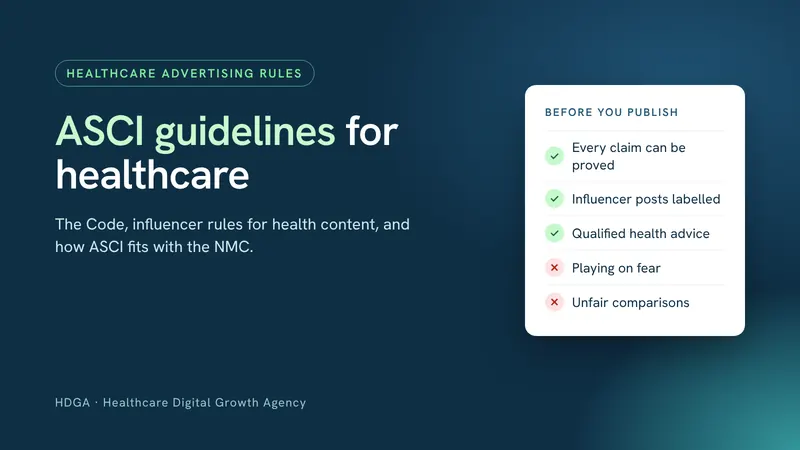
Most healthcare businesses in India think of the NMC when they think of advertising rules. But hospitals, diagnostic labs, wellness brands, nutrition companies, clinics and health apps are also answerable to the Advertising Standards Council of India (ASCI), the advertising industry's self-regulatory body. Its complaints reports have repeatedly placed healthcare among the sectors with the most objectionable ads.
This guide explains the ASCI guidelines as they apply to healthcare and wellness advertising: what the Code requires, the influencer rules for health content, how complaints work, and how ASCI fits with the NMC's 2026 guidelines and the law.
This is a practical overview, not legal advice. Read the current ASCI Code and guidelines on ascionline.in before relying on a specific point.
Who ASCI covers
ASCI's Code applies to advertising in any medium, including websites, social media, search ads and influencer posts, by any advertiser. In healthcare that includes:
- hospitals, clinics and diagnostic centres
- wellness centres, spas and weight-loss programmes
- nutrition, supplement and health food brands
- AYUSH products and practitioners
- health apps and online platforms
- over-the-counter products and devices
ASCI is self-regulatory, but its decisions carry weight: advertisers that do not comply can be referred to government authorities, including the Central Consumer Protection Authority, which enforces the Consumer Protection Act's rules on misleading advertisements.
The four principles of the ASCI Code
| Chapter | Principle | What it means for healthcare |
|---|---|---|
| I | Honest and truthful | Every claim must be true and backed by evidence you can produce |
| II | Not offensive | No content that is indecent or against generally accepted standards |
| III | Not harmful | No exploiting fear, encouraging unsafe practices or targeting children inappropriately |
| IV | Fair to competitors | No unfair comparisons or denigrating other providers |
Claims need proof
The practical test for most healthcare ads is Chapter I. If your ad says "results in 7 days", "clinically proven", "90% success rate" or "India's most advanced", you must be able to show the evidence, and it must support the claim exactly as a consumer would understand it. Small print that contradicts the headline does not fix a misleading claim.
Fear and vulnerability
Health advertising often plays on anxiety about weight, hair, skin, fertility or ageing. Ads that exploit fear, make people feel inadequate or imply that a normal condition needs treatment are among the most common complaints.
Influencer rules for health content
ASCI's Guidelines for Influencer Advertising in Digital Media apply when a brand has a material connection with an influencer, whether payment, free products or any other benefit.
Disclosure. Paid content must carry a clear label, such as Ad, Advertisement, Sponsored, Collaboration, Partnership or Free gift, upfront and prominent, not hidden in hashtags, bios or behind "more". On picture or video posts without text, the label goes on the visual itself. Platform tools such as "Paid partnership" supplement but do not replace the influencer's own label.
Health and wellness qualifications. Under an addendum updated in April 2025, influencers who give technical health or nutrition advice, such as claims to prevent, treat or cure a condition, must hold relevant qualifications (for example a medical degree, or certification as a nurse, nutritionist, dietitian, physiotherapist or psychologist). They must state those qualifications upfront: on screen, at the start of a video or podcast, or before the text in a blog. Generic content, such as a chef promoting a health food meal service, does not need qualifications.
Due diligence. Influencers should check that the advertiser can substantiate the claims they are asked to make, and advertisers are responsible for making sure the content complies.
In ASCI's FY 2025-26 annual complaints report, 97.3% of the 1,609 influencer ads it processed required modification.
How ASCI, the NMC and the law fit together
| Who it covers | Key point for healthcare | |
|---|---|---|
| ASCI Code | All advertisers | Claims must be truthful and substantiated; influencer disclosure |
| NMC guidelines, 2026 | Registered doctors, and clinical establishments with clinical establishment law | No testimonials, superiority claims, offers, influencer endorsements or AI-made patients |
| Drugs and Magic Remedies Act, 1954 | All advertisers | Bans ads for remedies for listed diseases and conditions |
| Consumer Protection Act, 2019 and CCPA guidelines | All advertisers | Misleading ads can attract penalties |
The NMC is stricter than ASCI in several respects. ASCI allows properly disclosed influencer advertising; the NMC prohibits doctors and clinical establishments from using influencer and celebrity endorsements. A hospital campaign can pass ASCI and still breach the NMC guidelines. See our guides to what hospitals may advertise and the Drugs and Magic Remedies Act. ASCI's FY 2025-26 report counted 274 cases involving products that violated the DMR Act.
How a complaint works
- Anyone, including a competitor or a consumer, can file a complaint with ASCI, and ASCI also monitors ads itself.
- ASCI asks the advertiser to respond and substantiate its claims.
- An independent committee decides whether the ad breaches the Code.
- If it does, the advertiser is asked to modify or withdraw it.
- Continued non-compliance can be reported to the relevant regulator.
Many advertisers choose to withdraw or modify an ad as soon as a complaint is raised.
A pre-launch checklist for healthcare ads
- Can we prove every claim with evidence we would show ASCI?
- Does the headline say the same thing as the small print?
- Does the ad play on fear, shame or insecurity?
- Do we compare ourselves with others, and can we prove the comparison?
- Is every influencer post labelled upfront, and is the influencer qualified for any health advice given?
- Does the ad mention any condition listed under the DMR Act?
- If a doctor or clinical establishment is advertising, does it also meet the NMC's 2026 guidelines?
Common questions
Are ASCI guidelines legally binding?
ASCI is a self-regulatory body, so its Code is not a law in itself. But the Consumer Protection Act and the CCPA's guidelines on misleading advertisements are legally enforceable, and ASCI can refer persistent offenders to regulators.
Do ASCI guidelines apply to doctors?
Yes, as advertisers. Doctors and clinical establishments must also follow the NMC's guidelines, which are stricter.
Can a hospital work with influencers?
Under the NMC's 2026 guidelines, influencer and celebrity endorsements are prohibited for doctors and clinical establishments. Wellness and nutrition brands that are not clinical establishments can work with influencers within ASCI's rules.
What labels must sponsored health posts use?
A clear label such as Ad, Advertisement, Sponsored, Collaboration or Partnership, shown upfront. Influencers giving technical health advice must also state their qualifications upfront.
What to do next
Run your current ads, landing pages and influencer posts through the checklist above, and fix anything you cannot prove. If you would like an independent review, see our ASCI advertising compliance and healthcare compliance advisory services, or book a call.
Sources
- ASCI: Guidelines for Influencer Advertising in Digital Media (2025)
- Storyboard18: ASCI modifies influencer guidelines for health and finance influencers (28 April 2025)
- Manifest: ASCI annual complaints report FY 2025-26 (28 May 2026)
- Campaign India: healthcare and offshore betting ads emerge as most violative in ASCI's annual complaints report
- The South First: NMC says no to patient testimonials, paid ads, AI promotions and guaranteed claims (October 2026)