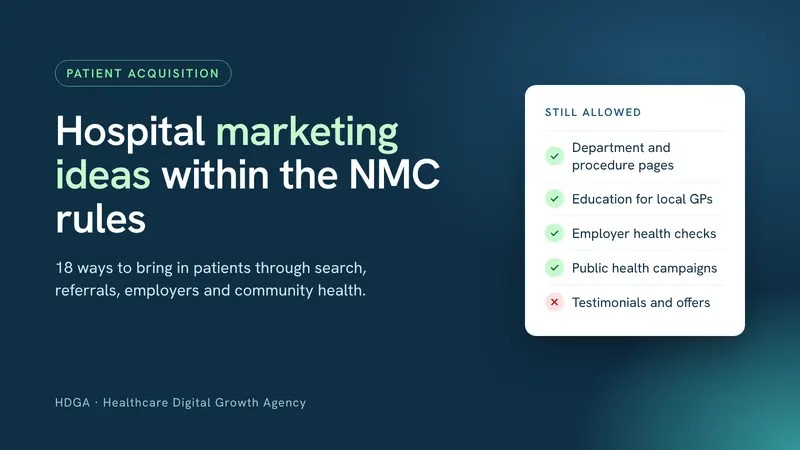
Since 6 October 2026, a large part of the traditional hospital marketing playbook is off limits: testimonial videos, "best hospital" claims, festival discounts, celebrity endorsements and agency deals paid per patient. Many marketing teams are left asking what they can still do. The answer is quite a lot, and the ideas that remain tend to work better over time, because they build trust rather than buying attention.
Here are 18 hospital marketing ideas that stay within the NMC's Guidelines on Ethical Advertising and Public Communication, grouped by where patients come from. For the rules themselves, read our guide to what hospitals may advertise.
Hospitals are regulated under the Clinical Establishments Act or state law, and the NMC guidelines are read with that law. This is a practical guide, not legal advice.
Patients who search
1. A page for every department and procedure
Patients search for "knee replacement in Pune" or "kidney stone treatment cost", not for your hospital's name. A strong page for each department and main procedure, with process, recovery, risks and factual charges, is the foundation of everything else. Our hospital website design checklist covers what each page needs.
2. Published charges and packages
Factual, transparent charges and packages are allowed (section 8.1(x)), and the Union Health Ministry asked states in October 2026 to make sure patients can easily find treatment costs. Hospitals that publish prices win the patients who are comparing.
3. Google Business Profiles for the hospital and its departments
A complete profile for the hospital, and separate profiles for public-facing departments such as emergency, diagnostics or maternity. See our Google Business Profile setup guide.
4. Answers that AI search can quote
Write clear, doctor-reviewed answers to the questions patients ask Google and AI assistants. Since AI Overviews and AI Mode arrived in India, being the cited source matters as much as ranking. See AI Overviews and AI Mode in India.
5. Factual search ads for key departments
Paid search ads for departments and services are not banned, as long as they make no superiority claims, guarantees or offers, and the landing pages meet the same standard. "Cardiology OPD in Andheri, Monday to Saturday, NABH accredited" is the model.
Patients who are referred
6. Continuing education for local doctors
Talks and workshops for general practitioners and specialists in your catchment area, run by your consultants on genuine clinical topics. They build professional relationships that bring appropriate referrals. Any payment for referring patients is prohibited, so keep it educational.
7. Clear referral pathways
Make referring easy: a direct number for referring doctors, a simple referral form, and a discharge summary sent back to the referring doctor promptly. Referring doctors return to hospitals that keep them informed.
8. Second-opinion clinics
A structured second-opinion service for cancer, cardiac or spine cases, with records reviewed by a named specialist, is a genuine service that patients search for. Describe it factually.
9. Insurance and TPA visibility
Many patients choose from their insurer's network list. Keep your empanelment current, make sure insurers and TPAs list you correctly, and show accepted insurers on your website.
Patients through employers and communities
10. Employer health check programmes
Annual health checks and occupational health services for companies, with packages priced factually, bring in patients and their families over the years. Agree terms with the employer, not commissions per patient.
11. Public health campaigns
Taking part in awareness campaigns, such as World Heart Day, breast cancer awareness month or diabetes screening drives, is allowed when they do not solicit patients (section 5.1). Partner with local bodies, schools or resident associations, and focus on education and early detection.
12. Health talks in your neighbourhood
Talks by your doctors at housing societies, workplaces and community halls on prevention, warning signs and when to see a doctor. Keep them educational, with no offers or booking drives.
13. Formal announcements of new services
A new cath lab, a new department or a new campus may be announced factually, without claims of being the best or first (section 3.2, Explanation II, and section 9.3). Local news coverage of a genuine first for the area often follows on its own.
Patients who have already been in
14. Discharge follow-up
A call or message the day after discharge, checking on recovery and repeating the aftercare instructions, is good care that patients remember and talk about.
15. Reminders and health updates, with consent
Appointment reminders, report alerts and health information for patients who agreed to receive them, with consent kept separate from consent for care, as the DPDP Act requires. See our DPDP consent form templates.
16. Fixing the patient experience
Long waits, confusing bills and unanswered phones cost more patients than any competitor does. Measure them, publish your standards internally and fix the worst first. Reviews follow experience.
17. Responding to reviews properly
Reply to every Google review politely, never confirming that the person was a patient, and invite unhappy reviewers to contact patient relations. Do not ask patients for reviews, repost reviews or offer anything in return for them.
18. Measuring booked patients by source
Track where every new patient came from (search, Maps, referring doctor, employer, insurer, community programme) and what each source costs. Hospitals that measure appointments rather than likes put their budget where patients actually come from.
Ideas to drop
- Testimonial videos and patient stories, even with consent
- Before-and-after photos
- "Best", "No. 1", "most trusted" or "100% success"
- Festival discounts, free-surgery camps and "limited slots" offers
- Celebrity and influencer endorsements
- Agency or influencer fees tied to the number of patients
- Asking patients for reviews, or buying reviews, ratings or higher rankings on platforms
Common questions
Can hospitals still run health camps?
As public health activity, focused on screening and awareness and not used to solicit patients, yes. A camp promoted as a way to bring patients in for procedures is a problem.
Can a hospital pay a doctor for referrals?
No. Payments linked to referring or procuring patients are prohibited.
Are corporate tie-ups allowed?
Yes, as service agreements with employers on factually priced packages. Avoid commissions per patient.
What is the single best marketing investment for a hospital now?
Department and procedure pages with factual information and charges, backed by complete Google profiles. They work for search, Maps and AI answers at once, and they stay within the rules.
What to do next
Pick three ideas from this list that fit your hospital's strengths, and measure them for three months by booked patients. If you want a full plan, see our healthcare digital marketing agency and healthcare marketing consulting pages, or book a call.
Sources
- NMC Guidelines on Ethical Advertising and Public Communication, 6 October 2026 (PDF via Medical Dialogues)
- Medical Dialogues: NMC specifies permitted and prohibited advertising practices for hospitals
- Medical Dialogues: NMC lists exceptions to prohibited advertising practices
- The South First: Centre asks states to ensure hospitals display service rates (13 October 2026)