India needs more hospital beds. It has about 1.3 beds for every 1,000 people, against a government target of 2, and private chains plan to spend around ₹40,000 crore adding 34,000 or more beds by FY2030. Those plans are mostly in metros and large tier 2 cities, which leaves room for well-run independent hospitals almost everywhere else.
Opening one is also among the most regulated and capital-heavy things you can do in India. This guide explains how to open a hospital in India: the steps in order, the licences you will need, what it costs per bed in 2026, how long it takes, and the mistakes that delay most projects.
Requirements vary by state and by the services you offer. Use this as a planning guide and confirm each approval with the relevant authority. It is not legal or financial advice.
The steps in order
- Feasibility study. Who will your patients be, what services are missing in your catchment area, and what do nearby hospitals charge? Look at population, insurance cover, government scheme demand and referral patterns.
- Service mix and size. Decide the specialties, number of beds, operation theatres, ICU beds and diagnostics. Many first hospitals start at 30 to 100 beds with a few strong specialties rather than trying to do everything.
- Legal entity. A private limited company, LLP, partnership, trust or society, chosen with your accountant for tax, funding and control.
- Site. Own land and build, lease a built-to-suit building, or convert an existing building. Check zoning, height, access for ambulances and fire tenders, parking and power supply before you sign.
- Design. Hire a healthcare architect who designs to the minimum standards for your category under the Clinical Establishments Act or state law, the National Building Code and NABH requirements.
- Funding. Combine promoter equity, bank loans, equipment finance and, increasingly, leasing.
- Approvals, in parallel with construction (see below).
- Equipment and IT. Medical equipment, medical gases, hospital information system, lab and imaging systems.
- Hiring and training. Doctors, nurses, technicians, administration and support staff, with time for mock drills and trial runs.
- Insurance and scheme empanelment. Apply to insurers, TPAs and government schemes as early as they allow; many patients choose from network lists.
- Launch. Soft opening with limited services, then a formal launch once systems are stable.
Licences and approvals
The core approvals for most hospitals:
| Approval | Issued by | Needed |
|---|---|---|
| Clinical establishment registration (central Act or state law) | State or district registering authority | Always |
| Building plan approval, completion and occupancy certificates | Municipal or development authority | Always |
| Fire NOC | State or municipal fire department | Always for hospitals; rules depend on height and occupancy |
| Biomedical waste authorisation and agreement with a common treatment facility | State Pollution Control Board | Always |
| Consent to establish and operate (air and water) | State Pollution Control Board | Depending on size and state |
| Drug licence for in-house pharmacy | State drug controller | If you run a pharmacy |
| AERB licence for X-ray, CT and other radiation equipment | AERB, through eLORA | If you have imaging |
| PCPNDT registration | District appropriate authority | If you have ultrasound |
| Blood centre or blood storage licence | State drug controller and CDSCO | If you have one |
| Lift, DG set, electrical and boiler approvals | State inspectorates | As applicable |
| Labour registrations: EPFO, ESIC, shops and establishments, professional tax | Central and state bodies | Always |
Some services need their own registrations: medical termination of pregnancy, organ transplantation, assisted reproduction and narcotic drugs. NABH accreditation is voluntary but expected by insurers and many patients; plan for it from the design stage.
For the paperwork behind registration, see our clinical establishment registration documents checklist and Clinical Establishment Act registration guide.
How much it costs
Cost is usually discussed per bed, and published figures vary because they include different things: land, building, equipment, working capital.
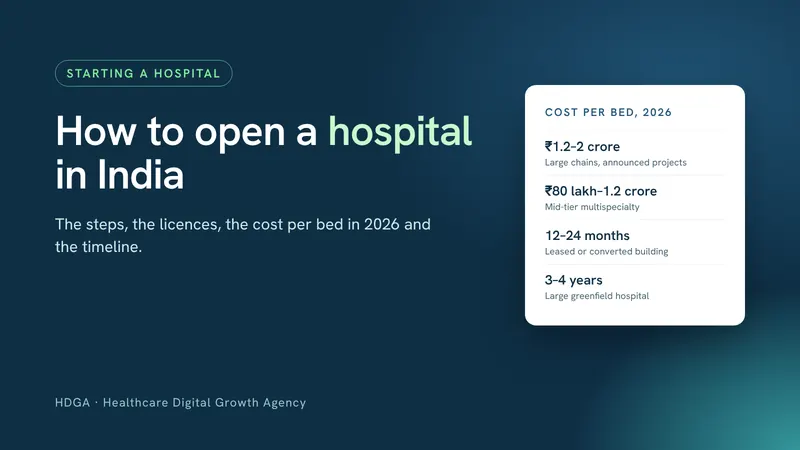
- Large chains: announced projects work out to roughly ₹1.2 crore to ₹2 crore per bed. Shalby Hospitals has said it spends about ₹1.5 to 3 crore per bed in metros, and about ₹1.5 crore in Mumbai on an asset-light model.
- Mid-tier multispecialty hospitals: analysts put typical spending at around ₹80 lakh to ₹1.2 crore per bed, with premium tertiary hospitals in big cities going higher.
- Smaller hospitals in leased buildings, with fewer high-end specialties, can come in well below these figures.
The biggest drivers are land and construction, the specialty mix (oncology and cardiac care need far more equipment than general surgery), the number of ICU beds and theatres, and whether you buy or lease equipment.
Use our multi-specialty hospital setup cost calculator to estimate the investment, monthly costs and payback for your own bed count, occupancy and revenue per bed.
How long it takes
- Converting or leasing an existing building: often 12 to 24 months from decision to first patient.
- Greenfield construction: usually several years. A 500-bed hospital takes three to four years to reach its first patient, according to one 2026 project guide.
- Break-even: new hospitals usually lose money for a period after opening while occupancy builds. Plan working capital for it.
Approvals that commonly take longest are building and fire approvals, pollution control consents and AERB licensing. Start them as early as your design allows.
Where new hospitals go wrong
- Building before checking the land: zoning, height or access problems that block the fire NOC.
- Too many specialties too soon: high fixed costs before referral patterns exist.
- Underestimating working capital: the months of losses before occupancy rises.
- Late insurance empanelment: patients cannot use cashless cover in the first months.
- Hiring late: no time to train teams and run mock drills.
- Marketing as an afterthought: no Google profiles, department pages or referral relationships ready for opening day.
Marketing a new hospital within the rules
The NMC's 2026 advertising guidelines allow a formal, factual announcement of a new hospital, its departments and services, without claims of being the best or first. Before opening:
- set up Google Business Profiles for the hospital and its public-facing departments
- publish department, doctor and procedure pages with factual charges
- meet local GPs and specialists for referral relationships built on education, not payments
- plan community health talks and screening programmes that do not solicit patients
See our guides to hospital marketing ideas, what hospitals may advertise and hospital website design.
Common questions
Can a non-doctor open a hospital in India?
Generally yes. A hospital can be owned by a company, trust, society or individual who is not a doctor, but it must be run under a qualified medical person in charge and employ registered doctors. Check your state's clinical establishment law.
How much money is required to open a hospital in India?
It depends on beds, specialties and whether you own the building. Large chains announce roughly ₹1.2 to 2 crore per bed; smaller hospitals in leased buildings with a narrower service mix cost considerably less. Use our calculator for an estimate.
What is the minimum number of beds for a hospital?
There is no single national minimum. Categories and standards differ by state and by the type of establishment; small nursing homes may have fewer than 10 beds.
Is NABH accreditation mandatory?
No, it is voluntary, but insurers, corporates and many patients look for it, and in some states it speeds up registration.
What to do next
Write down your target specialties, bed count and catchment area, and run the numbers in our hospital setup cost calculator. If you would like help with planning, approvals and launch, see our hospital launch consulting and NABH consulting services, or book a call.
Sources
- ICRA: private sector investments driving capacity growth, outlay of ₹40,000 crore seen over FY2026 to FY2030 (18 February 2026)
- Upstox: India's hospital bed shortage, is private expansion enough?
- Business Today: private hospitals to inject ₹40,000 crore into India's healthcare expansion (3 July 2026)
- Business Standard: Shalby Hospitals plans ₹1,000 crore expansion
- NIIR: how to start a multi-speciality hospital
- Understanding the hospital sector: the economics of capex
- NABH: requirements for healthcare organisations applying for inspection